In Exercises 1–3, perform the indicated operations and write the result in standard form. ___ ___ 2√−49 + 3√−64
Verified step by step guidance
1
Recognize that the expressions involve square roots of negative numbers, which means we are dealing with imaginary numbers. Recall that \(\sqrt{-a} = \sqrt{a} \times i\), where \(i\) is the imaginary unit with the property \(i^2 = -1\).
Rewrite each term by separating the negative sign inside the square root: \(2\sqrt{-49} = 2\sqrt{49} \times i\) and \(3\sqrt{-64} = 3\sqrt{64} \times i\).
Calculate the square roots of the positive numbers: \(\sqrt{49} = 7\) and \(\sqrt{64} = 8\).
Substitute these values back into the expression: \(2 \times 7 \times i + 3 \times 8 \times i\).
Combine like terms by factoring out \(i\): \((2 \times 7 + 3 \times 8) i\), which simplifies to \((14 + 24) i\). This is the expression in standard form \(a + bi\), where \(a\) is the real part and \(b\) is the coefficient of the imaginary part.
Verified video answer for a similar problem:
This video solution was recommended by our tutors as helpful for the problem above
Video duration:
3m
Play a video:
0 Comments
Key Concepts
Here are the essential concepts you must grasp in order to answer the question correctly.
Imaginary Numbers and the Imaginary Unit i
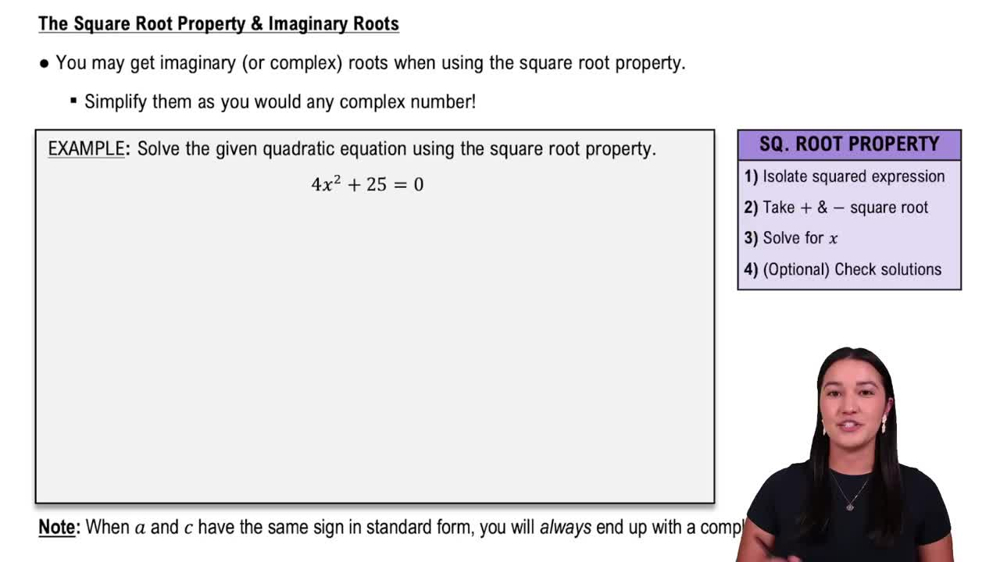
Imaginary numbers arise when taking the square root of negative numbers, which is not defined in the real number system. The imaginary unit i is defined as √(-1), allowing us to express roots of negative numbers as multiples of i, such as √(-49) = 7i.
To simplify radicals with negative radicands, factor out the negative sign as i² or i, then simplify the positive part. For example, √(-64) = √(64) × √(-1) = 8i. This process helps convert complex radicals into a standard form involving real and imaginary parts.
The standard form of a complex number is a + bi, where a and b are real numbers and i is the imaginary unit. After performing operations on imaginary numbers, results should be expressed in this form to clearly separate the real and imaginary components.

 3:16 minutes
 Verified step by step guidance
 2:20
2:20