In Exercises 59–74, convert each polar equation to a rectangular equation. Then use a rectangular coordinate system to graph the rectangular equation. r = 4 csc θ
Ch. 5 - Complex Numbers, Polar Coordinates and Parametric Equations

All textbooks
Blitzer 3rd Edition
Ch. 5 - Complex Numbers, Polar Coordinates and Parametric Equations
Problem 5
Blitzer 3rd Edition
Ch. 5 - Complex Numbers, Polar Coordinates and Parametric Equations
Problem 5Chapter 5, Problem 5
In Exercises 1–10, perform the indicated operations and write the result in standard form. (7 + 8i)(7 − 8i)
Verified step by step guidance1
Recognize that the expression \((7 + 8i)(7 - 8i)\) is a product of two complex conjugates. The product of conjugates follows the formula \((a + bi)(a - bi) = a^2 + b^2\).
Identify the real part \(a = 7\) and the imaginary coefficient \(b = 8\) from the given expression.
Apply the formula by squaring the real part and the imaginary coefficient: calculate \(7^2\) and \(8^2\).
Add the squares together to get the result in the form \(a^2 + b^2\), which will be a real number since the imaginary parts cancel out.
Write the final answer in standard form \(x + yi\), where \(y = 0\) because the product of conjugates is always a real number.

Verified video answer for a similar problem:
This video solution was recommended by our tutors as helpful for the problem above.
Video duration:
2mWas this helpful?
Key Concepts
Here are the essential concepts you must grasp in order to answer the question correctly.
Complex Numbers and Standard Form
Complex numbers are expressed in the form a + bi, where a is the real part and b is the imaginary part. The standard form refers to writing the result explicitly as a sum of a real number and an imaginary number. Understanding this form is essential for interpreting and simplifying complex number operations.
Recommended video:
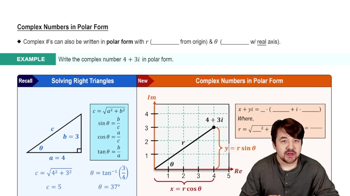
Complex Numbers In Polar Form
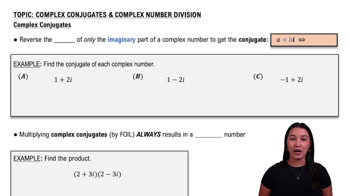
Multiplication of Complex Conjugates
Multiplying a complex number by its conjugate (changing the sign of the imaginary part) results in a real number. This product equals the sum of the squares of the real and imaginary parts, i.e., (a + bi)(a - bi) = a² + b². This property simplifies calculations and eliminates imaginary components.
Recommended video:
Complex Conjugates
Use of the Imaginary Unit i
The imaginary unit i is defined by i² = -1. When multiplying complex numbers, powers of i must be simplified using this definition. Recognizing and applying i² = -1 allows conversion of imaginary terms into real numbers, facilitating the simplification of expressions.
Recommended video:
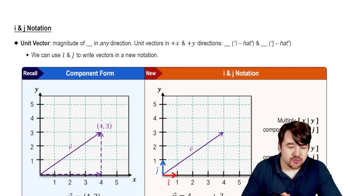
i & j Notation
Related Practice
Textbook Question
912
views
Textbook Question
In Exercises 1–8, add or subtract as indicated and write the result in standard form. 6 − (−5 + 4i) − (−13 − i)
921
views
Textbook Question
In Exercises 59–74, convert each polar equation to a rectangular equation. Then use a rectangular coordinate system to graph the rectangular equation. r = 8
866
views
Textbook Question
In Exercises 53–64, use DeMoivre's Theorem to find the indicated power of the complex number. Write answers in rectangular form. (1 + i)⁵
571
views
Textbook Question
In Exercises 53–64, use DeMoivre's Theorem to find the indicated power of the complex number. Write answers in rectangular form. [1/2 (cos π/12 + i sin π/12)]⁶
606
views
Textbook Question
In Exercises 53–58, perform the indicated operation(s) and write the result in standard form. ___ ___ 5√(−16) + 3√(−81)
715
views