Textbook Question
In Exercises 1–3, perform the indicated operations and write the result in standard form. ___ ___ 2√−49 + 3√−64
730
views

 Blitzer 3rd EditionCh. 5 - Complex Numbers, Polar Coordinates and Parametric EquationsProblem 4
 Verified step by step guidance
 04:47
04:47
 4:22
4:22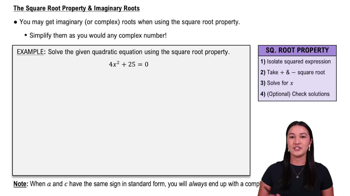 2:20
2:20In Exercises 1–3, perform the indicated operations and write the result in standard form. ___ ___ 2√−49 + 3√−64
In Exercises 1–8, parametric equations and a value for the parameter t are given. Find the coordinates of the point on the plane curve described by the parametric equations corresponding to the given value of t. x = t² + 3, y = 6 − t³; t = 2
In Exercises 21–28, divide and express the result in standard form.
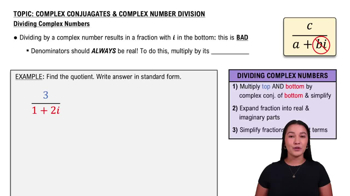
2+3i / 2+i
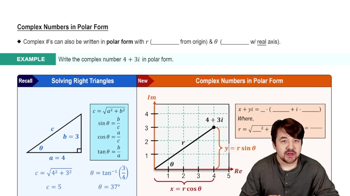
_ Write −√3 + i in polar form.
In Exercises 45–52, use your answers from Exercises 41–44 and the parametric equations given in Exercises 41–44 to find a set of parametric equations for the conic section or the line.
Ellipse: Center: (−2,3); Vertices: 5 units to the left and right of the center; Endpoints of Minor Axis: 2 units above and below the center
In Exercises 53–56, find two different sets of parametric equations for each rectangular equation. y = x² + 4