(Modeling) Length of a Sag Curve When a highway goes downhill and then uphill, it has a sag curve. Sag curves are designed so that at night, headlights shine sufficiently far down the road to allow a safe stopping distance. See the figure. S and L are in feet. The minimum length L of a sag curve is determined by the height h of the car's headlights above the pavement, the downhill grade θ₁ < 0°, the uphill grade θ₂ > 0°, and the safe stopping distance S for a given speed limit. In addition, L is dependent on the vertical alignment of the headlights. Headlights are usually pointed upward at a slight angle α above the horizontal of the car. Using these quantities, for a 55 mph speed limit, L can be modeled by the formula (θ₂ - θ₁)S² L = ————————— , 200(h + S tan α) where S < L. (Data from Mannering, F., and W. Kilareski, Principles of Highway Engineering and Traffic Analysis, Second Edition, John Wiley and Sons.) Compute length L, to the nearest foot, if h = 1.9 ft, α = 0.9°, θ₁ = -3°, θ₂ = 4°, and S = 336 ft.
Table of contents
- 0. Review of College Algebra4h 45m
- 1. Measuring Angles40m
- 2. Trigonometric Functions on Right Triangles2h 5m
- 3. Unit Circle1h 19m
- 4. Graphing Trigonometric Functions1h 19m
- 5. Inverse Trigonometric Functions and Basic Trigonometric Equations1h 41m
- 6. Trigonometric Identities and More Equations2h 34m
- 7. Non-Right Triangles1h 38m
- 8. Vectors2h 25m
- 9. Polar Equations2h 5m
- 10. Parametric Equations1h 6m
- 11. Graphing Complex Numbers1h 7m
3. Unit Circle
Trigonometric Functions on the Unit Circle
Problem 4.13
Textbook Question
Graph each function over a one-period interval.
y = - (1/2) csc (x + π/2)
Verified step by step guidance1
Step 1: Recognize that the function is a transformation of the basic cosecant function, \( y = \csc(x) \). The given function is \( y = -\frac{1}{2} \csc(x + \frac{\pi}{2}) \).
Step 2: Identify the transformations: The \( +\frac{\pi}{2} \) inside the function indicates a horizontal shift to the left by \( \frac{\pi}{2} \) units. The \( -\frac{1}{2} \) outside the function indicates a vertical stretch by a factor of \( \frac{1}{2} \) and a reflection across the x-axis.
Step 3: Determine the period of the cosecant function. The period of \( \csc(x) \) is \( 2\pi \). Since there is no horizontal scaling factor, the period remains \( 2\pi \).
Step 4: Identify the vertical asymptotes of the function. For \( \csc(x) \), the vertical asymptotes occur where \( \sin(x) = 0 \). For \( \csc(x + \frac{\pi}{2}) \), this occurs at \( x = -\frac{\pi}{2}, \frac{3\pi}{2}, \ldots \).
Step 5: Sketch the graph over one period \([-\frac{\pi}{2}, \frac{3\pi}{2}]\), applying the transformations: shift the basic \( \csc(x) \) graph left by \( \frac{\pi}{2} \), vertically stretch by \( \frac{1}{2} \), and reflect it across the x-axis.
Verified video answer for a similar problem:This video solution was recommended by our tutors as helpful for the problem above
Play a video:
0 Comments
Key Concepts
Here are the essential concepts you must grasp in order to answer the question correctly.
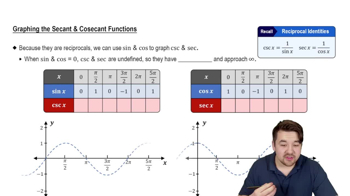
Cosecant Function
The cosecant function, denoted as csc(x), is the reciprocal of the sine function. It is defined as csc(x) = 1/sin(x). The cosecant function has a range of all real numbers except for values between -1 and 1, and it is undefined wherever the sine function is zero. Understanding the properties of the cosecant function is essential for graphing it accurately.
Recommended video:
Graphs of Secant and Cosecant Functions
Graphing Trigonometric Functions
Graphing trigonometric functions involves plotting their values over a specified interval, typically one period. For the cosecant function, this includes identifying key points, asymptotes, and the overall shape of the graph. The period of the cosecant function is 2π, and transformations such as vertical shifts and reflections must be considered when graphing functions like y = - (1/2) csc(x + π/2).
Recommended video:
Introduction to Trigonometric Functions
Transformations of Functions
Transformations of functions refer to changes made to the basic function's graph, including shifts, stretches, and reflections. In the given function, y = - (1/2) csc(x + π/2), the term (x + π/2) indicates a horizontal shift to the left by π/2, while the negative sign reflects the graph across the x-axis, and the factor of -1/2 compresses the graph vertically. Understanding these transformations is crucial for accurately graphing the function.
Recommended video:
Domain and Range of Function Transformations
Related Videos
Related Practice
Textbook Question
491
views