(Modeling) Fish's View of the World The figure shows a fish's view of the world above the surface of the water. (Data from Walker, J., 'The Amateur Scientist,' Scientific American.) Suppose that a light ray comes from the horizon, enters the water, and strikes the fish's eye. Assume that this ray gives a value of 90° for angle θ₁ in the formula for Snell's law. (In a practical situation, this angle would probably be a little less than 90°.) The speed of light in water is about 2.254 x 10⁸ m per sec. Find angle θ₂ to the nearest tenth.
Table of contents
- 0. Review of College Algebra4h 45m
- 1. Measuring Angles40m
- 2. Trigonometric Functions on Right Triangles2h 5m
- 3. Unit Circle1h 19m
- 4. Graphing Trigonometric Functions1h 19m
- 5. Inverse Trigonometric Functions and Basic Trigonometric Equations1h 41m
- 6. Trigonometric Identities and More Equations2h 34m
- 7. Non-Right Triangles1h 38m
- 8. Vectors2h 25m
- 9. Polar Equations2h 5m
- 10. Parametric Equations1h 6m
- 11. Graphing Complex Numbers1h 7m
3. Unit Circle
Trigonometric Functions on the Unit Circle
Multiple Choice
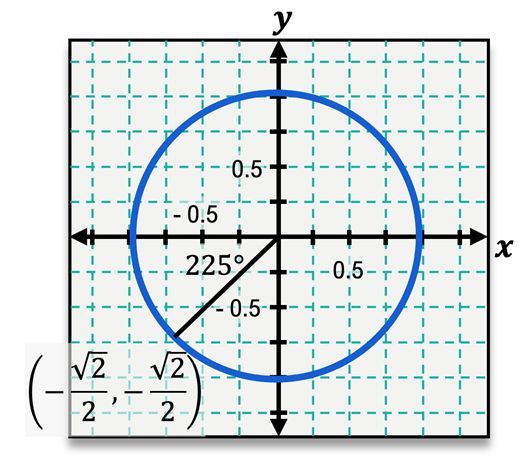
Find the sine, cosine, and tangent of each angle using the unit circle.
θ=225°,(−22,−22) 
A
sinθ=−22,cosθ=−22,tanθ=2
B
sinθ=22,cosθ=−22,tanθ=−1
C
sinθ=−22,cosθ=−22,tanθ=1
D
sinθ=22,cosθ=22,tanθ=12
0 Comments
Verified step by step guidance1
The unit circle is a circle with a radius of 1 centered at the origin of a coordinate plane. Each point on the unit circle corresponds to an angle θ measured from the positive x-axis.
For an angle θ = 225°, locate the point on the unit circle. The coordinates of this point are given as (-\(\frac{\sqrt{2}\)}{2}, -\(\frac{\sqrt{2}\)}{2}).
The x-coordinate of the point on the unit circle represents the cosine of the angle, and the y-coordinate represents the sine of the angle. Therefore, \(\cos\)(225°) = -\(\frac{\sqrt{2}\)}{2} and \(\sin\)(225°) = -\(\frac{\sqrt{2}\)}{2}.
The tangent of an angle θ is the ratio of the sine to the cosine, \(\tan\)(θ) = \(\frac{\sin(θ)}{\cos(θ)}\). For θ = 225°, \(\tan\)(225°) = \(\frac{-\frac{\sqrt{2}\)}{2}}{-\(\frac{\sqrt{2}\)}{2}} = 1.
Verify the quadrant: 225° is in the third quadrant where both sine and cosine are negative, confirming that \(\sin\)(225°) = -\(\frac{\sqrt{2}\)}{2}, \(\cos\)(225°) = -\(\frac{\sqrt{2}\)}{2}, and \(\tan\)(225°) = 1 are correct.
Related Videos
Related Practice
Textbook Question
533
views

