


(Modeling) Speed of Light When a light ray travels from one medium, such as air, to another medium, such as water or glass, the speed of the light changes, and the light ray is bent, or refracted, at the boundary between the two media. (This is why objects under water appear to be in a different position from where they really are.) It can be shown in physics that these changes are related by Snell's law c₁ = sin θ₁ , c₂ sin θ₂ where c₁ is the speed of light in the first medium, c₂ is the speed of light in the second medium, and θ₁ and θ₂ are the angles shown in the figure. In Exercises 81 and 82, assume that c₁ = 3 x 10⁸ m per sec. Find the speed of light in the second medium for each of the following. a. θ₁ = 46°, θ₂ = 31° b. θ₁ = 39°, θ₂ = 28°
3. Unit Circle
Trigonometric Functions on the Unit Circle
Multiple Choice
Find the sine, cosine, and tangent of each angle using the unit circle.
rad, 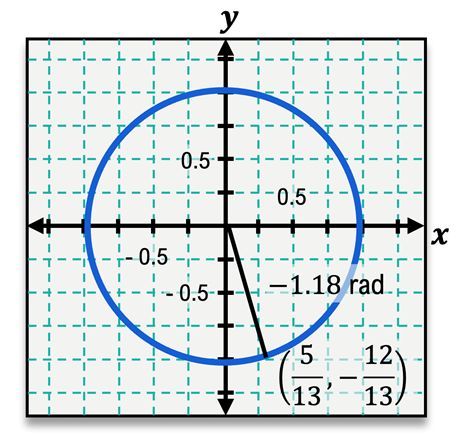
A
B
C
D
 Verified step by step guidance
1
Identify the coordinates of the point on the unit circle corresponding to the angle θ = -1.18 rad. From the image, the coordinates are (\(\frac{5}{13}\), -\(\frac{12}{13}\)).
Recall that on the unit circle, the x-coordinate of a point is the cosine of the angle, and the y-coordinate is the sine of the angle. Therefore, \(\cos\)(\(\theta\)) = \(\frac{5}{13}\) and \(\sin\)(\(\theta\)) = -\(\frac{12}{13}\).
To find the tangent of the angle, use the identity \(\tan\)(\(\theta\)) = \(\frac{\sin(\theta)}{\cos(\theta)}\). Substitute the values: \(\tan\)(\(\theta\)) = \(\frac{-\frac{12}{13}\)}{\(\frac{5}{13}\)}.
Simplify the expression for tangent: \(\tan\)(\(\theta\)) = \(\frac{-12}{13}\) \(\times\) \(\frac{13}{5}\) = -\(\frac{12}{5}\).
Verify the results: \(\sin\)(\(\theta\)) = -\(\frac{12}{13}\), \(\cos\)(\(\theta\)) = \(\frac{5}{13}\), \(\tan\)(\(\theta\)) = -\(\frac{12}{5}\). These match the correct answer provided in the problem statement.
Related Videos
Related Practice
Textbook Question
488
views


