Use a calculator to approximate each value in decimal degrees. θ = tan⁻¹ (-7.7828641)
Verified step by step guidance
1
Recognize that the problem asks for the angle \( \theta \) such that \( \tan(\theta) = -7.7828641 \), and that \( \theta = \tan^{-1}(-7.7828641) \) represents the inverse tangent (arctangent) function.
Recall that the inverse tangent function \( \tan^{-1}(x) \) returns an angle in radians or degrees depending on the calculator mode, so ensure your calculator is set to degree mode to get the answer in decimal degrees.
Enter the value \(-7.7828641\) into the calculator and then press the inverse tangent function key (usually labeled as \( \tan^{-1} \) or \( \arctan \)) to find \( \theta \).
Interpret the result from the calculator as the principal value of \( \theta \), which will be an angle between \(-90^\circ\) and \(90^\circ\) because the range of \( \tan^{-1} \) is \( (-90^\circ, 90^\circ) \).
If needed, consider the context or quadrant of the angle based on the sign of the tangent value, but since the problem only asks for the approximate decimal degree value, the calculator output is sufficient.
Verified video answer for a similar problem:
This video solution was recommended by our tutors as helpful for the problem above
Play a video:
0 Comments
Key Concepts
Here are the essential concepts you must grasp in order to answer the question correctly.
Inverse Tangent Function (tan⁻¹ or arctan)
The inverse tangent function returns the angle whose tangent is a given number. It is used to find an angle when the ratio of the opposite side to the adjacent side in a right triangle is known. The output is typically in radians or degrees, depending on the calculator settings.
Calculators can operate in different angle modes, commonly degrees or radians. To correctly interpret the inverse tangent result in decimal degrees, ensure the calculator is set to degree mode. This setting affects the numerical output of trigonometric functions.
Decimal degrees express angles as a decimal number rather than degrees, minutes, and seconds. This format simplifies calculations and is commonly used in scientific and engineering contexts. Approximating the angle in decimal degrees involves evaluating the inverse tangent and converting if necessary.

 Verified step by step guidance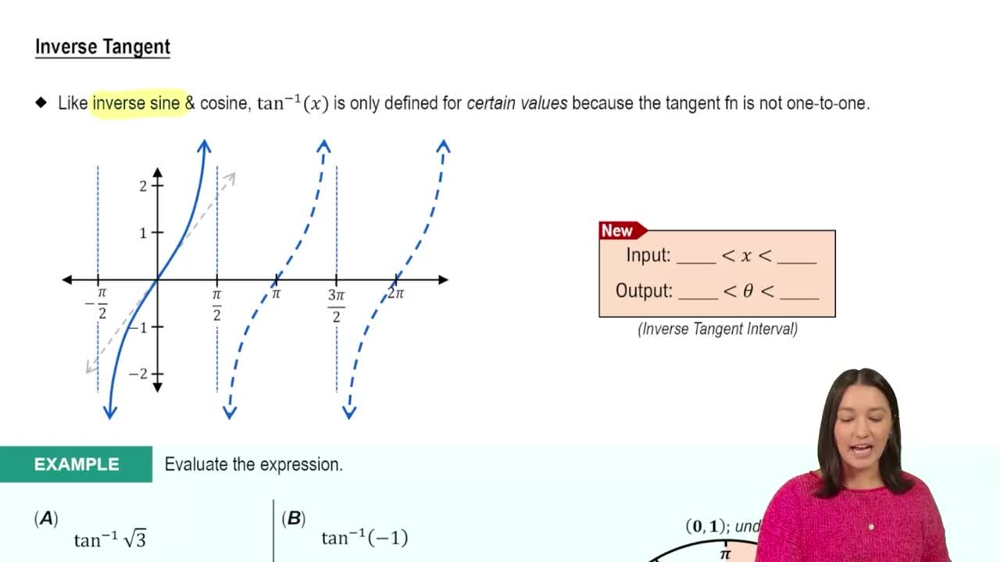
 3:17
3:17