Use a calculator to approximate each value in decimal degrees. θ = cot⁻¹ (-0.60724226)
Verified step by step guidance
1
Recall that the inverse cotangent function, \(\cot^{-1}(x)\), gives an angle \(\theta\) such that \(\cot(\theta) = x\). Here, you need to find \(\theta\) where \(\cot(\theta) = -0.60724226\).
Since most calculators do not have a direct \(\cot^{-1}\) function, use the identity \(\cot(\theta) = \frac{1}{\tan(\theta)}\). Therefore, \(\theta = \cot^{-1}(x) = \tan^{-1}\left(\frac{1}{x}\right)\).
Calculate the reciprocal of the given value: \(\frac{1}{-0.60724226}\), which will be used as the input for the \(\tan^{-1}\) function.
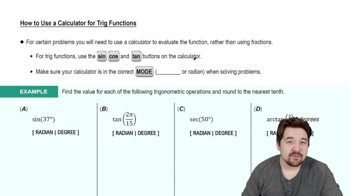
Use your calculator to find \(\theta = \tan^{-1}\left(\frac{1}{-0.60724226}\right)\), making sure your calculator is set to degree mode to get the answer in decimal degrees.
Interpret the result carefully: since the cotangent value is negative, the angle \(\theta\) will lie in either the second or fourth quadrant. Adjust the angle accordingly if your calculator returns a principal value outside the expected range for \(\cot^{-1}\).
Verified video answer for a similar problem:
This video solution was recommended by our tutors as helpful for the problem above
Play a video:
0 Comments
Key Concepts
Here are the essential concepts you must grasp in order to answer the question correctly.
Inverse Cotangent Function (cot⁻¹)
The inverse cotangent function, cot⁻¹, returns the angle whose cotangent is a given value. It is the inverse of the cotangent function, which is the ratio of the adjacent side to the opposite side in a right triangle. Understanding its range and behavior is essential for correctly interpreting the angle.
Using a Calculator for Inverse Trigonometric Functions
Calculators typically provide inverse trigonometric functions like arctan, arcsin, and arccos, but may not have a direct cot⁻¹ button. To find cot⁻¹(x), you can use the identity cot⁻¹(x) = tan⁻¹(1/x), considering the sign and quadrant to get the correct angle in degrees.
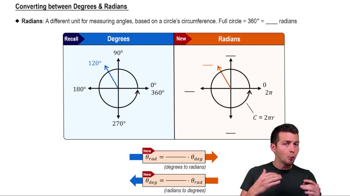
Inverse trigonometric functions often return angles in radians by default. To express the angle in decimal degrees, multiply the radian value by 180/π. This conversion is necessary to match the problem's requirement for decimal degrees.

 Verified step by step guidance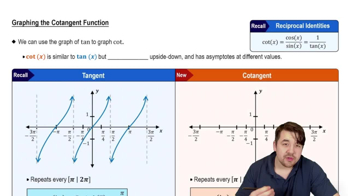
 5:37
5:37