Use a calculator to approximate each value in decimal degrees. θ = csc⁻¹ 1.9422833
Verified step by step guidance
1
Recall that the cosecant function is the reciprocal of the sine function, so \( \csc \theta = x \) implies \( \sin \theta = \frac{1}{x} \).
Rewrite the given expression \( \theta = \csc^{-1} 1.9422833 \) as \( \theta = \sin^{-1} \left( \frac{1}{1.9422833} \right) \).
Calculate the reciprocal of 1.9422833 to find \( \sin \theta \), which is \( \frac{1}{1.9422833} \).
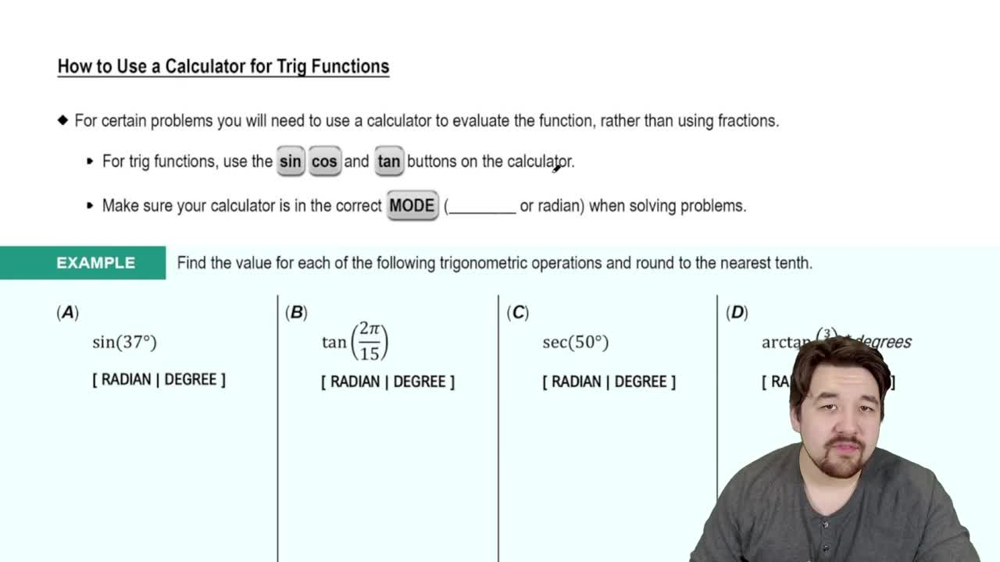
Use a calculator to find the inverse sine (arcsin) of the value obtained in the previous step, making sure your calculator is set to degree mode.
The result from the calculator will give you the approximate value of \( \theta \) in decimal degrees.
Verified video answer for a similar problem:
This video solution was recommended by our tutors as helpful for the problem above
Play a video:
0 Comments
Key Concepts
Here are the essential concepts you must grasp in order to answer the question correctly.
Inverse Cosecant Function (csc⁻¹)
The inverse cosecant function, csc⁻¹(x), returns the angle whose cosecant is x. Since cosecant is the reciprocal of sine, csc⁻¹(x) = sin⁻¹(1/x). Understanding this relationship helps convert the problem into a more familiar inverse sine calculation.
Cosecant is the reciprocal of sine, meaning csc(θ) = 1/sin(θ). This reciprocal relationship is essential for rewriting the inverse cosecant expression in terms of inverse sine, which is commonly available on calculators.
Calculators typically provide inverse sine functions and allow switching between radians and degrees. To approximate θ in decimal degrees, convert csc⁻¹(x) to sin⁻¹(1/x) and ensure the calculator is set to degree mode before computing the angle.

 Verified step by step guidance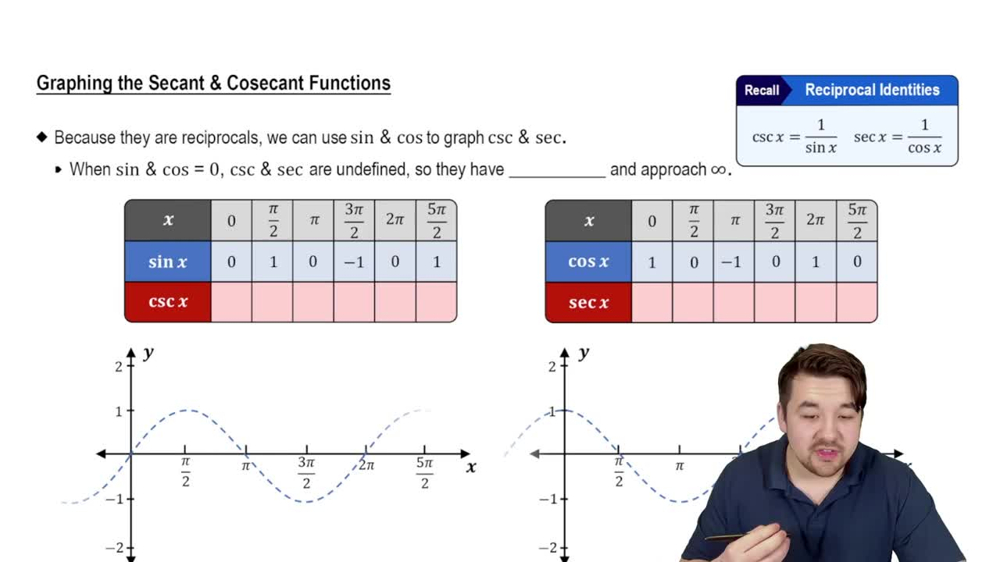
 6:22
6:22