11. Graphing Complex Numbers
Polar Form of Complex Numbers

 2:55 minutes
Problem 15b
Textbook Question
In Exercises 15–18, write each complex number in rectangular form. If necessary, round to the nearest tenth. 8(cos 60° + i sin 60°)
 Verified step by step guidance
1
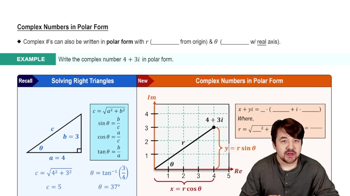
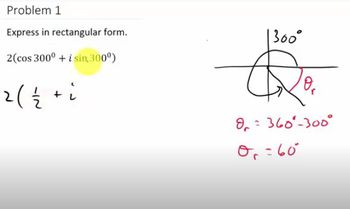
Recognize that the given expression is in polar form: $r(\cos \theta + i \sin \theta)$, where $r = 8$ and $\theta = 60^\circ$.
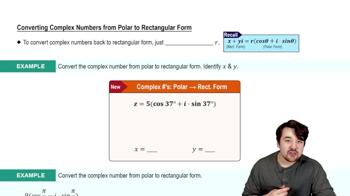
Recall that the rectangular form of a complex number is $a + bi$, where $a = r \cos \theta$ and $b = r \sin \theta$.
Calculate $a$ by using $a = 8 \cos 60^\circ$. Use the fact that $\cos 60^\circ = \frac{1}{2}$.
Calculate $b$ by using $b = 8 \sin 60^\circ$. Use the fact that $\sin 60^\circ = \frac{\sqrt{3}}{2}$.
Combine the results to express the complex number in rectangular form as $a + bi$.
Verified video answer for a similar problem:This video solution was recommended by our tutors as helpful for the problem above

Video duration:
2mWas this helpful?
Key Concepts
Here are the essential concepts you must grasp in order to answer the question correctly.
Complex Numbers
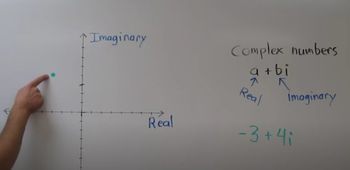
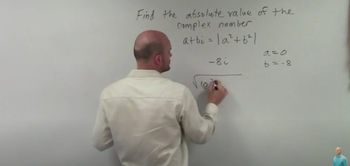
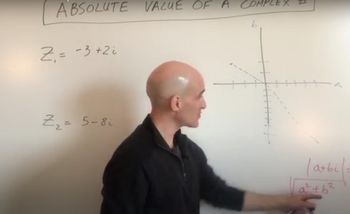
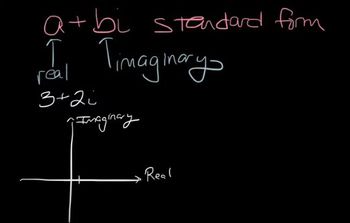
Complex numbers are numbers that have a real part and an imaginary part, typically expressed in the form a + bi, where a is the real part and b is the coefficient of the imaginary unit i. In trigonometric form, a complex number can be represented as r(cos θ + i sin θ), where r is the magnitude and θ is the angle. Understanding how to convert between these forms is essential for solving problems involving complex numbers.
Recommended video:
 4:22
4:22
Dividing Complex Numbers
Polar to Rectangular Conversion
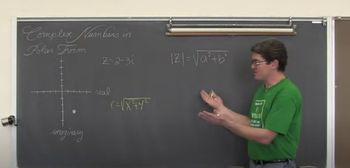
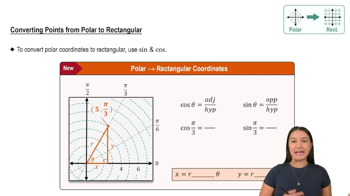
The conversion from polar to rectangular form involves using the relationships x = r cos θ and y = r sin θ, where (x, y) are the rectangular coordinates. This process allows us to express a complex number in the standard form a + bi. For the given complex number, substituting the values of r and θ will yield the rectangular coordinates necessary for the solution.
Recommended video:
 06:17
06:17Convert Points from Polar to Rectangular
Trigonometric Values
Trigonometric values such as cos(θ) and sin(θ) are fundamental in determining the components of a complex number in polar form. For example, cos(60°) equals 0.5 and sin(60°) equals √3/2. Knowing these values is crucial for accurately converting the complex number from its trigonometric representation to rectangular form.
Recommended video:
 5:32
5:32Fundamental Trigonometric Identities
4:47mWatch next
Master Complex Numbers In Polar Form with a bite sized video explanation from Patrick
Start learningRelated Videos
Related Practice