In Exercises 15–18, write each complex number in rectangular form. If necessary, round to the nearest tenth.6 (cos 2π/3 + i sin 2π/3)
Verified step by step guidance
1
Step 1: Recognize the given form as polar form. The complex number is given in the form of r(cos θ + i sin θ), where r is the modulus and θ is the argument.
Step 2: Identify the values of r and θ. Here, r = 6 and θ = \(\frac{2\pi}{3}\).
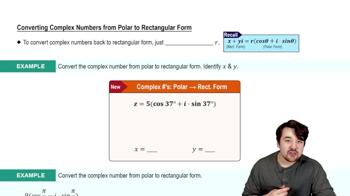
Step 3: Use the conversion formulas to find the rectangular form. The rectangular form is given by x + yi, where x = r \(\cdot\) \(\cos\)(θ) and y = r \(\cdot\) \(\sin\)(θ).
Step 4: Calculate x using the formula x = r \(\cdot\) \(\cos\)(θ). Substitute the values to get x = 6 \(\cdot\) \(\cos\)(\(\frac{2\pi}{3}\)).
Step 5: Calculate y using the formula y = r \(\cdot\) \(\sin\)(θ). Substitute the values to get y = 6 \(\cdot\) \(\sin\)(\(\frac{2\pi}{3}\)).
Verified video answer for a similar problem:
This video solution was recommended by our tutors as helpful for the problem above
Video duration:
3m
Play a video:
0 Comments
Key Concepts
Here are the essential concepts you must grasp in order to answer the question correctly.
Complex Numbers
Complex numbers are numbers that have a real part and an imaginary part, typically expressed in the form a + bi, where a is the real part and b is the imaginary part. In trigonometric form, a complex number can be represented as r(cos θ + i sin θ), where r is the magnitude and θ is the angle. Understanding how to convert between these forms is essential for solving problems involving complex numbers.
The conversion from polar to rectangular form involves using the relationships x = r cos θ and y = r sin θ, where (x, y) are the rectangular coordinates and r is the magnitude of the complex number. This process allows us to express a complex number in the standard form a + bi. Mastery of this conversion is crucial for accurately representing complex numbers in different contexts.
Trigonometric functions, such as sine and cosine, are fundamental in determining the coordinates of points on the unit circle. In the context of complex numbers, these functions help define the angle θ in polar coordinates. Understanding how to evaluate these functions at specific angles, such as 2π/3, is necessary for converting complex numbers from trigonometric to rectangular form.