Understand the given polar equation: \(r = 1 + \sin \theta\). This equation expresses the radius \(r\) as a function of the angle \(\theta\) in polar coordinates.
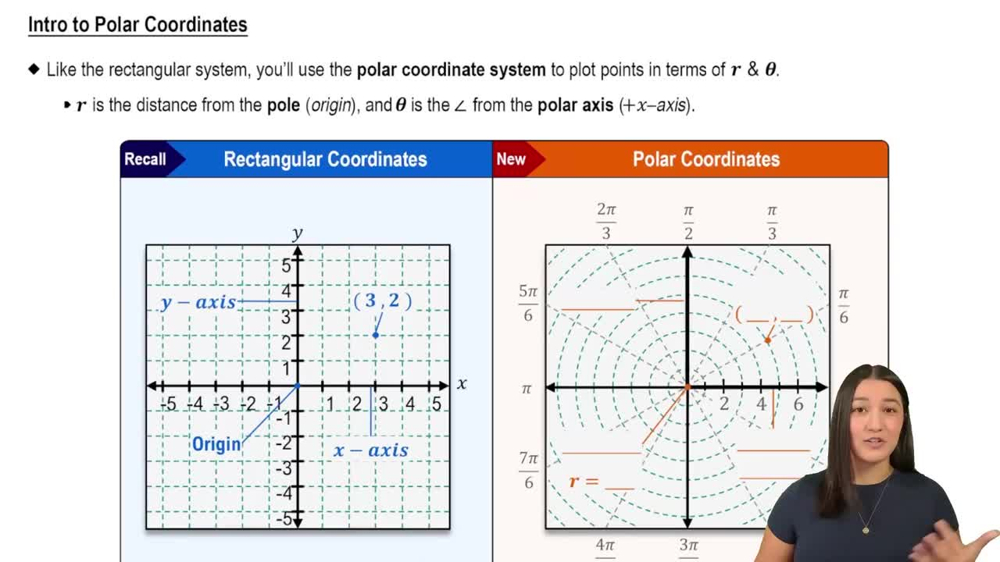
Recall that in polar coordinates, \(r\) is the distance from the origin and \(\theta\) is the angle measured from the positive x-axis. To graph the equation, you will plot points \((r, \theta)\) for various values of \(\theta\) between \$0$ and \(2\pi\).
Create a table of values by choosing several values of \(\theta\) (for example, \$0\(, \(\frac{\pi}{6}\), \(\frac{\pi}{4}\), \(\frac{\pi}{2}\), \(\pi\), \(\frac{3\pi}{2}\), \(2\pi\)) and calculate the corresponding \)r$ using the formula \(r = 1 + \sin \theta\).
Plot each point on the polar coordinate plane by moving \(r\) units from the origin at the angle \(\theta\). Connect these points smoothly to reveal the shape of the graph.
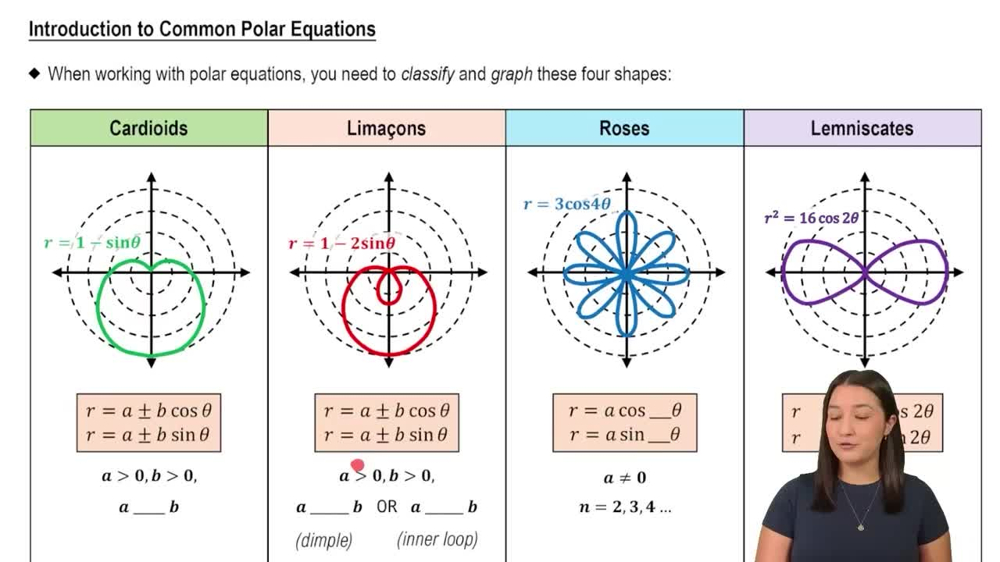
Recognize that the graph of \(r = 1 + \sin \theta\) is a cardioid, a heart-shaped curve, which is symmetric about the vertical axis. This understanding helps in sketching the curve accurately.
Verified video answer for a similar problem:
This video solution was recommended by our tutors as helpful for the problem above
Video duration:
2m
Play a video:
0 Comments
Key Concepts
Here are the essential concepts you must grasp in order to answer the question correctly.
Polar Coordinates and Polar Equations
Polar coordinates represent points in a plane using a radius and an angle (r, θ) instead of Cartesian coordinates (x, y). A polar equation expresses the radius r as a function of the angle θ, allowing the graph to be plotted by calculating r for various θ values.
To graph a polar equation like r = 1 + sin θ, compute r for multiple θ values between 0 and 2π, then plot the points (r, θ) in polar form. Connecting these points reveals the shape, which often corresponds to known curves such as circles, cardioids, or limacons.
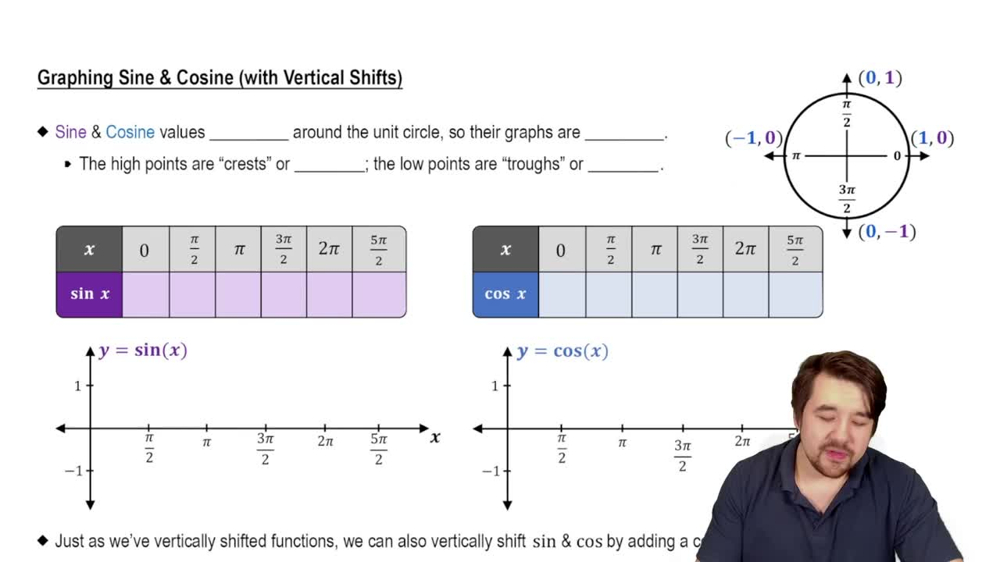
The sine function varies between -1 and 1, affecting the radius r in the equation r = 1 + sin θ. This variation creates characteristic shapes like cardioids or limacons, where the maximum and minimum values of sin θ determine the curve's size and symmetry relative to the polar axis.

 2:39 minutes
 Verified step by step guidance
 05:32
05:32