Convert x² + (y + 8)² = 64 to a polar equation that expresses r in terms of θ.
Table of contents
- 0. Review of College Algebra4h 45m
- 1. Measuring Angles40m
- 2. Trigonometric Functions on Right Triangles2h 5m
- 3. Unit Circle1h 19m
- 4. Graphing Trigonometric Functions1h 19m
- 5. Inverse Trigonometric Functions and Basic Trigonometric Equations1h 41m
- 6. Trigonometric Identities and More Equations2h 34m
- 7. Non-Right Triangles1h 38m
- 8. Vectors2h 25m
- 9. Polar Equations2h 5m
- 10. Parametric Equations1h 6m
- 11. Graphing Complex Numbers1h 7m
9. Polar Equations
Polar Coordinate System
Problem 15
Textbook Question
In Exercises 11–20, use a polar coordinate system like the one shown for Exercises 1–10 to plot each point with the given polar coordinates. (3, 4π/3)
Verified step by step guidance1
Recall that polar coordinates are given in the form \((r, \theta)\), where \(r\) is the distance from the origin and \(\theta\) is the angle measured from the positive x-axis (polar axis) in radians.
Identify the given coordinates: \(r = 3\) and \(\theta = \frac{4\pi}{3}\) radians. This means the point is 3 units away from the origin at an angle of \(\frac{4\pi}{3}\) radians.
Convert the angle \(\frac{4\pi}{3}\) radians to degrees if needed for easier visualization: multiply by \(\frac{180}{\pi}\) to get degrees, but this step is optional if you are comfortable with radians.
On the polar coordinate system, start at the positive x-axis and rotate counterclockwise by the angle \(\frac{4\pi}{3}\) radians. This places you in the third quadrant since \(\frac{4\pi}{3}\) is greater than \(\pi\) (which is \(180^\circ\)).
From the origin, move outward along the line at angle \(\frac{4\pi}{3}\) by a distance of 3 units. Mark this point on the graph.
Verified video answer for a similar problem:This video solution was recommended by our tutors as helpful for the problem above
Video duration:
1mPlay a video:
0 Comments
Key Concepts
Here are the essential concepts you must grasp in order to answer the question correctly.
Polar Coordinate System
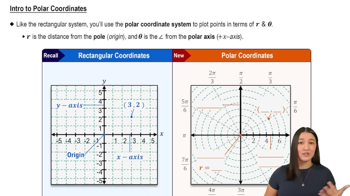
The polar coordinate system represents points in a plane using a distance from the origin (radius r) and an angle (θ) measured from the positive x-axis. Each point is expressed as (r, θ), where r ≥ 0 and θ is typically in radians or degrees.
Recommended video:
Intro to Polar Coordinates
Plotting Points Using Polar Coordinates
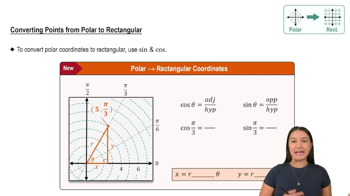
To plot a point given in polar coordinates (r, θ), start at the origin, rotate counterclockwise by the angle θ, then move outward along that direction by the distance r. Negative values of r indicate moving in the opposite direction of the angle θ.
Recommended video:
Convert Points from Polar to Rectangular
Angle Measurement in Radians
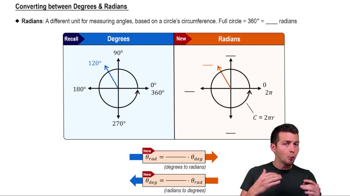
Angles in polar coordinates are often measured in radians, where 2π radians equal 360 degrees. Understanding radian measure helps accurately locate points on the plane, such as 4π/3 radians, which corresponds to 240 degrees.
Recommended video:
Converting between Degrees & Radians
Related Videos
Related Practice
Textbook Question
679
views