Ch. 5 - Complex Numbers, Polar Coordinates and Parametric Equations
Blitzer - Trigonometry 3rd Edition
Blitzer3rd EditionTrigonometryISBN: 9780137316601Not the one you use?Change textbook
Chapter 5, Problem 9

Indicate if the point with the given polar coordinates is represented by A, B, C, or D on the graph. (−3, −3π/4)

Verified step by step guidance
1
Recall that polar coordinates are given in the form \((r, \theta)\), where \(r\) is the distance from the origin and \(\theta\) is the angle measured from the positive x-axis.
Note that the radius \(r\) is negative (\(r = -3\)), which means the point lies in the direction opposite to the angle \(\theta = -\frac{3\pi}{4}\).
First, find the equivalent positive angle by adding \(2\pi\) if needed, or understand that \(-\frac{3\pi}{4}\) is the same as rotating clockwise \(\frac{3\pi}{4}\) radians from the positive x-axis.
Since \(r\) is negative, move in the direction opposite to \(\theta = -\frac{3\pi}{4}\). This means you add \(\pi\) to the angle to find the actual direction of the point: \(\theta_{actual} = -\frac{3\pi}{4} + \pi = \frac{\pi}{4}\).
Locate the point on the graph at distance \(3\) from the origin along the angle \(\frac{\pi}{4}\) (which is 45 degrees in the first quadrant). Identify which labeled point (A, B, C, or D) corresponds to this position.

Verified video answer for a similar problem:

This video solution was recommended by our tutors as helpful for the problem above.
Video duration:
3m
Was this helpful?

Key Concepts

Here are the essential concepts you must grasp in order to answer the question correctly.

Polar Coordinates

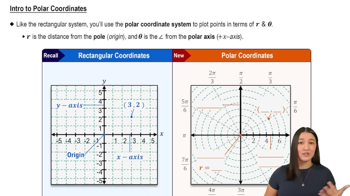
Polar coordinates represent a point in the plane using a radius and an angle, written as (r, θ). The radius r indicates the distance from the origin, and θ is the angle measured from the positive x-axis, usually in radians. Understanding how to interpret these coordinates is essential for locating points on a polar graph.
Recommended video:
05:32
Intro to Polar Coordinates

Negative Radius in Polar Coordinates

A negative radius means the point is located in the direction opposite to the angle θ. To plot (−r, θ), you move r units in the direction θ + π (180 degrees). This concept is crucial for correctly identifying points when the radius is negative.
Recommended video:
05:32
Intro to Polar Coordinates

Angle Measurement and Reference Angles

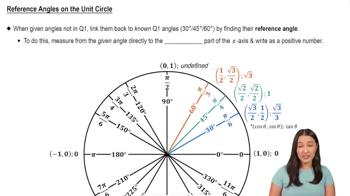
Angles in polar coordinates are often given in radians and can be positive or negative. Negative angles indicate clockwise rotation from the positive x-axis. Understanding how to convert and interpret these angles, including adding or subtracting 2π to find coterminal angles, helps in accurately locating points on the graph.
Recommended video:
5:31
Reference Angles on the Unit Circle