Substitute \( \theta = \frac{2\pi}{5} \) into the cofunction identity: \( \cos\left(\frac{2\pi}{5}\right) = \sin\left(\frac{\pi}{2} - \frac{2\pi}{5}\right) \).
Simplify the expression inside the sine function: \( \frac{\pi}{2} - \frac{2\pi}{5} \).
The cofunction with the same value is \( \sin\left(\frac{\pi}{2} - \frac{2\pi}{5}\right) \).
Verified video answer for a similar problem:
This video solution was recommended by our tutors as helpful for the problem above
Video duration:
3m
Play a video:
0 Comments
Key Concepts
Here are the essential concepts you must grasp in order to answer the question correctly.
Cofunction Identities
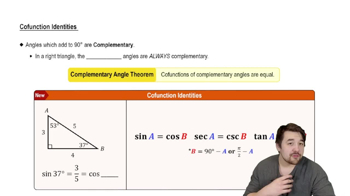
Cofunction identities in trigonometry relate the values of trigonometric functions of complementary angles. For example, the sine of an angle is equal to the cosine of its complement, and vice versa. This means that sin(θ) = cos(90° - θ) and cos(θ) = sin(90° - θ). Understanding these identities is crucial for finding cofunctions that yield the same value.
The unit circle is a fundamental concept in trigonometry that defines the relationship between angles and the coordinates of points on a circle with a radius of one. Each angle corresponds to a point on the circle, where the x-coordinate represents the cosine and the y-coordinate represents the sine of that angle. Familiarity with the unit circle helps in visualizing and calculating trigonometric values, including cofunctions.
Trigonometric functions are periodic, meaning they repeat their values in regular intervals. For cosine, the period is 2π, which indicates that cos(θ) = cos(θ + 2πn) for any integer n. This property is essential when evaluating expressions like cos(2π/5), as it allows for the identification of equivalent angles and their corresponding cofunction values.