In Exercises 31–38, find a cofunction with the same value as the given expression.csc 25°
Verified step by step guidance
1
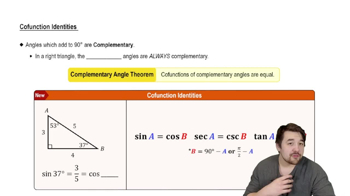
Understand that cofunctions are pairs of trigonometric functions that are equal when their angles are complementary. The cofunction identities are: \( \sin(90^\circ - \theta) = \cos(\theta) \), \( \cos(90^\circ - \theta) = \sin(\theta) \), \( \tan(90^\circ - \theta) = \cot(\theta) \), \( \cot(90^\circ - \theta) = \tan(\theta) \), \( \sec(90^\circ - \theta) = \csc(\theta) \), and \( \csc(90^\circ - \theta) = \sec(\theta) \).
Identify the given expression: \( \csc 25^\circ \).
Use the cofunction identity for cosecant: \( \csc(\theta) = \sec(90^\circ - \theta) \).
Substitute \( \theta = 25^\circ \) into the cofunction identity: \( \csc(25^\circ) = \sec(90^\circ - 25^\circ) \).
Simplify the expression: \( \sec(65^\circ) \). Therefore, \( \sec 65^\circ \) is the cofunction with the same value as \( \csc 25^\circ \).
Verified video answer for a similar problem:
This video solution was recommended by our tutors as helpful for the problem above
Video duration:
1m
Play a video:
0 Comments
Key Concepts
Here are the essential concepts you must grasp in order to answer the question correctly.
Cofunction Identities
Cofunction identities in trigonometry relate the values of trigonometric functions of complementary angles. Specifically, for any angle θ, the sine of θ is equal to the cosine of its complement (90° - θ). This means that functions like sine, cosine, tangent, and cotangent have corresponding cofunctions that can be used to find equivalent values.
The cosecant function, denoted as csc, is the reciprocal of the sine function. For an angle θ, csc(θ) = 1/sin(θ). Understanding this relationship is crucial for finding cofunctions, as it allows us to express csc(25°) in terms of another trigonometric function that can be evaluated using complementary angles.
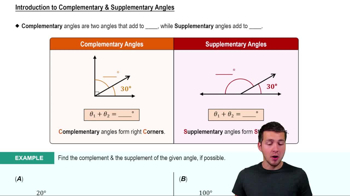
Complementary angles are two angles whose measures add up to 90 degrees. In the context of trigonometric functions, knowing the complementary angle allows us to use cofunction identities effectively. For example, since csc(25°) relates to sin(65°) (where 65° is the complement of 25°), this relationship is key to finding the cofunction with the same value.