In Exercises 83–94, use a right triangle to write each expression as an algebraic expression. Assume that x is positive and that the given inverse trigonometric function is defined for the expression in x. tan (cos⁻¹ x)
Verified step by step guidance
1
Recognize that the expression \( \tan(\cos^{-1} x) \) involves the tangent of an angle whose cosine is \( x \). Let \( \theta = \cos^{-1} x \), so \( \cos \theta = x \).
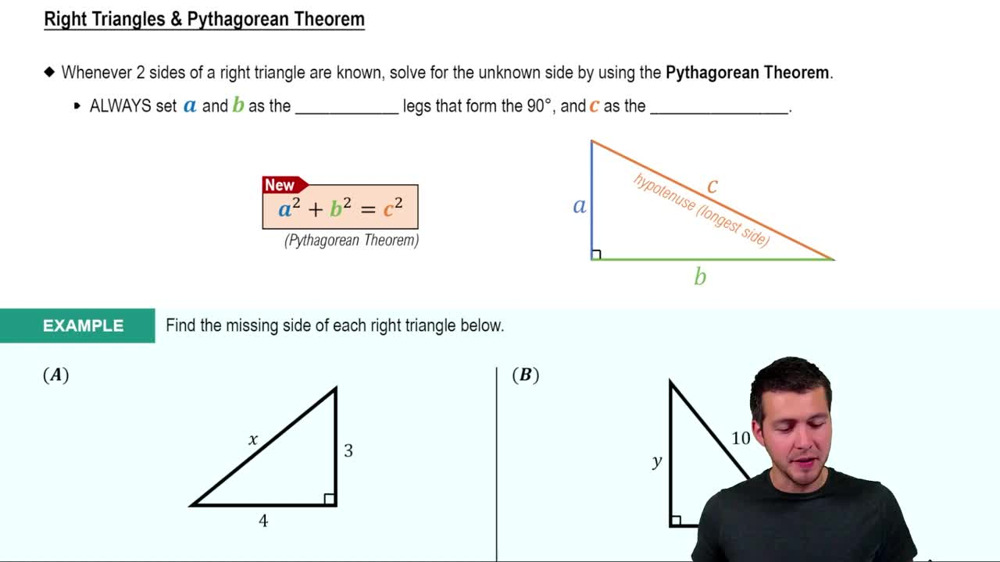
Since \( \theta \) is an angle in a right triangle, draw a right triangle where the adjacent side to angle \( \theta \) is \( x \) and the hypotenuse is 1 (because cosine is adjacent over hypotenuse).
Use the Pythagorean theorem to find the length of the opposite side: \( \text{opposite} = \sqrt{1^2 - x^2} = \sqrt{1 - x^2} \).
Recall that \( \tan \theta = \frac{\text{opposite}}{\text{adjacent}} \). Substitute the values found: \( \tan(\cos^{-1} x) = \frac{\sqrt{1 - x^2}}{x} \).
Express the final algebraic expression for \( \tan(\cos^{-1} x) \) as \( \frac{\sqrt{1 - x^2}}{x} \), assuming \( x > 0 \) to keep the expression defined.
Verified video answer for a similar problem:
This video solution was recommended by our tutors as helpful for the problem above
Video duration:
4m
Play a video:
1 Comment
Key Concepts
Here are the essential concepts you must grasp in order to answer the question correctly.
Inverse Trigonometric Functions
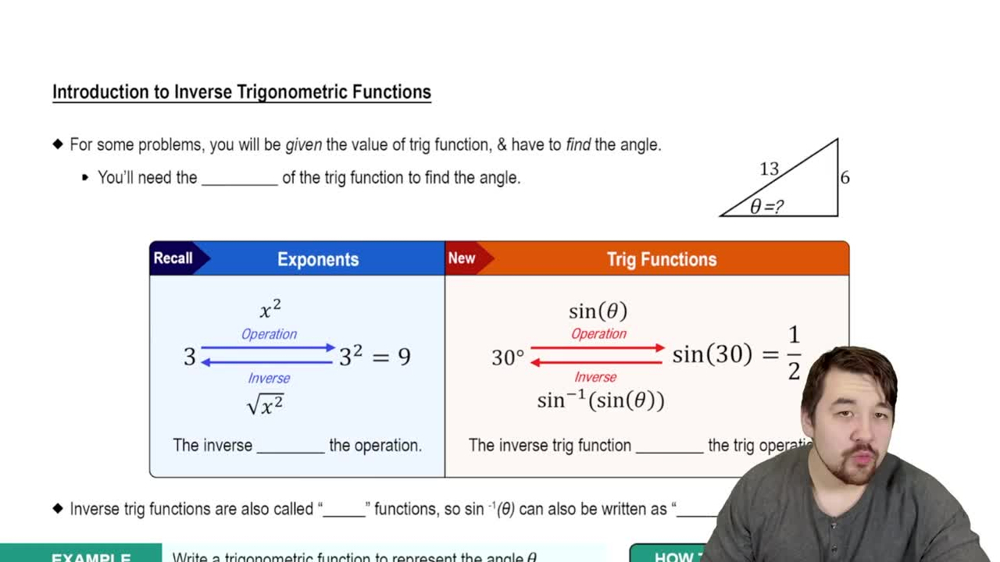
Inverse trigonometric functions, like cos⁻¹(x), return an angle whose trigonometric ratio equals x. Understanding how to interpret these functions is essential for converting expressions involving inverse trig functions into geometric or algebraic forms.
Right Triangle Definitions of Trigonometric Ratios
Trigonometric ratios such as sine, cosine, and tangent can be represented as ratios of sides in a right triangle. Using a right triangle to represent an angle from an inverse trig function helps translate the problem into algebraic expressions involving side lengths.
Solving Right Triangles with the Pythagorean Theorem
Pythagorean Theorem
The Pythagorean theorem relates the sides of a right triangle: a² + b² = c². It is crucial for finding missing side lengths when one side and an angle are known, enabling the expression of trigonometric ratios purely in terms of x.

 4:19 minutes
 Verified step by step guidance
 4:28
4:28