Evaluate the expression.
Table of contents
- 0. Review of College Algebra4h 45m
- 1. Measuring Angles40m
- 2. Trigonometric Functions on Right Triangles2h 5m
- 3. Unit Circle1h 19m
- 4. Graphing Trigonometric Functions1h 19m
- 5. Inverse Trigonometric Functions and Basic Trigonometric Equations1h 41m
- 6. Trigonometric Identities and More Equations2h 34m
- 7. Non-Right Triangles1h 38m
- 8. Vectors2h 25m
- 9. Polar Equations2h 5m
- 10. Parametric Equations1h 6m
- 11. Graphing Complex Numbers1h 7m
5. Inverse Trigonometric Functions and Basic Trigonometric Equations
Evaluate Composite Trig Functions
Problem 39
Textbook Question
In Exercises 39–54, find the exact value of each expression, if possible. Do not use a calculator. sin(sin⁻¹ 0.9)
Verified step by step guidance1
Recognize that the expression is \( \sin(\sin^{-1}(0.9)) \). The function \( \sin^{-1} \) (also called arcsin) is the inverse of the sine function, which means it 'undoes' the sine function within its domain.
Recall the property of inverse functions: for any value \( x \) in the domain of \( \sin^{-1} \), \( \sin(\sin^{-1}(x)) = x \). This holds true because \( \sin^{-1}(x) \) gives the angle whose sine is \( x \).
Check that the input value \( 0.9 \) is within the domain of \( \sin^{-1} \), which is \( [-1, 1] \). Since \( 0.9 \) is within this range, the property applies directly.
Therefore, the expression simplifies directly to \( 0.9 \) without further calculation.
Summarize that \( \sin(\sin^{-1}(0.9)) = 0.9 \) because the sine and arcsine functions are inverses on the domain \( [-1, 1] \).
Verified video answer for a similar problem:This video solution was recommended by our tutors as helpful for the problem above
Video duration:
1mPlay a video:
0 Comments
Key Concepts
Here are the essential concepts you must grasp in order to answer the question correctly.
Inverse Sine Function (sin⁻¹ or arcsin)
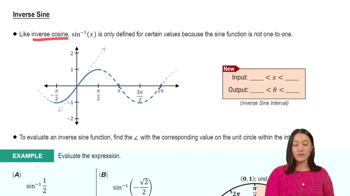
The inverse sine function, denoted sin⁻¹ or arcsin, returns the angle whose sine is a given value. It is defined for inputs between -1 and 1 and outputs angles in the range [-π/2, π/2]. Understanding this helps in interpreting expressions like sin(sin⁻¹ x).
Recommended video:
Inverse Sine
Composition of Sine and Inverse Sine Functions
When sine and its inverse are composed as sin(sin⁻¹ x), the result simplifies to x for all x in the domain [-1, 1]. This property is crucial for evaluating expressions without a calculator, as it allows direct simplification.
Recommended video:
Inverse Sine
Domain and Range Restrictions
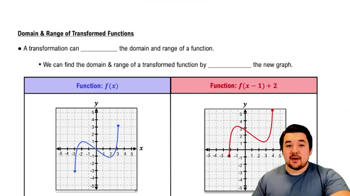
The domain of sin⁻¹ is [-1, 1], and its range is limited to angles between -π/2 and π/2. Recognizing these restrictions ensures the expression is valid and helps avoid errors when simplifying or evaluating trigonometric expressions.
Recommended video:
Domain and Range of Function Transformations
Related Videos
Related Practice
Multiple Choice
440
views