Ch. 2 - Graphs of the Trigonometric Functions; Inverse Trigonometric Functions
Blitzer - Trigonometry 3rd Edition
Blitzer3rd EditionTrigonometryISBN: 9780137316601Not the one you use?Change textbook
Chapter 2, Problem 45

In Exercises 39–54, find the exact value of each expression, if possible. Do not use a calculator. tan (tan⁻¹ 125)

Verified step by step guidance
1
Recognize that the expression is \( \tan(\tan^{-1}(125)) \). Here, \( \tan^{-1} \) is the inverse tangent function, also called arctangent, which returns an angle whose tangent is the given number.
Understand that \( \tan^{-1}(125) \) gives an angle \( \theta \) such that \( \tan(\theta) = 125 \).
Since \( \tan \) and \( \tan^{-1} \) are inverse functions, applying \( \tan \) to \( \tan^{-1}(125) \) essentially returns the original input value, provided the angle is within the principal range of \( \tan^{-1} \).
Therefore, the expression simplifies to \( 125 \) because \( \tan(\tan^{-1}(x)) = x \) for all real numbers \( x \).
No further calculation is needed, and the exact value of the expression is \( 125 \).

Verified video answer for a similar problem:

This video solution was recommended by our tutors as helpful for the problem above.
Video duration:
1m
Was this helpful?

Key Concepts

Here are the essential concepts you must grasp in order to answer the question correctly.

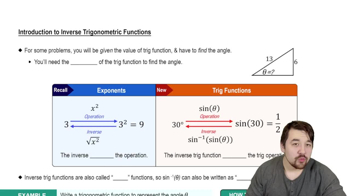
Inverse Trigonometric Functions

Inverse trigonometric functions, like tan⁻¹ (arctan), return the angle whose trigonometric ratio equals a given value. For example, tan⁻¹(125) gives the angle whose tangent is 125. Understanding this helps in simplifying expressions involving inverse functions.
Recommended video:
4:28
Introduction to Inverse Trig Functions

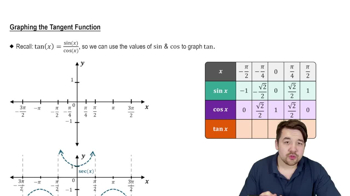
Tangent Function and Its Properties

The tangent function relates an angle in a right triangle to the ratio of the opposite side over the adjacent side. It is periodic and defined for all real numbers except odd multiples of 90°. Knowing that tan and tan⁻¹ are inverse functions helps simplify tan(tan⁻¹(x)) to x within the function's domain.
Recommended video:
5:43
Introduction to Tangent Graph

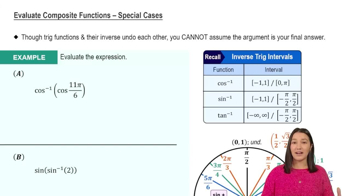
Simplification of Composite Functions

When a function and its inverse are composed, such as tan(tan⁻¹(x)), the result simplifies to x, provided x is within the domain of the inverse function. This principle allows direct evaluation of expressions without a calculator by recognizing the cancellation effect.
Recommended video:
3:48
Evaluate Composite Functions - Special Cases