Given \( \sec \theta = \frac{x+4}{x} \), we can express \( \cos \theta \) as \( \cos \theta = \frac{x}{x+4} \).
Use the Pythagorean identity: \( \tan^2 \theta = \sec^2 \theta - 1 \).
Substitute \( \sec \theta = \frac{x+4}{x} \) into the identity to find \( \tan^2 \theta = \left(\frac{x+4}{x}\right)^2 - 1 \).
Simplify the expression for \( \tan^2 \theta \) and then take the square root to find \( \tan \theta \).
Verified video answer for a similar problem:
This video solution was recommended by our tutors as helpful for the problem above
Play a video:
0 Comments
Key Concepts
Here are the essential concepts you must grasp in order to answer the question correctly.
Secant Function
The secant function, denoted as sec θ, is the reciprocal of the cosine function. It is defined as sec θ = 1/cos θ. In this context, sec θ = (x+4)/x implies a relationship between the angle θ and the variable x, which can be used to derive other trigonometric functions.
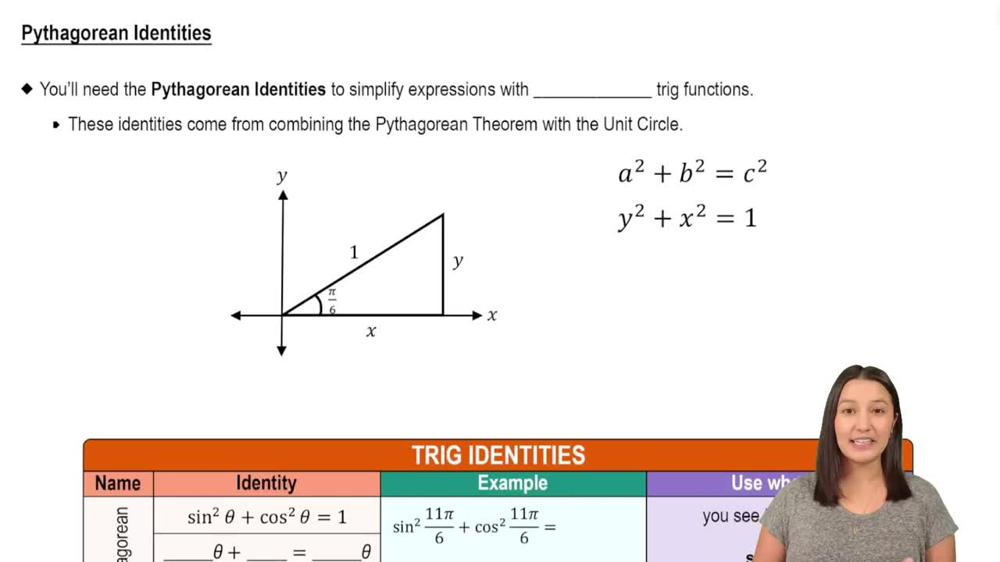
The Pythagorean identity states that for any angle θ, the relationship sin² θ + cos² θ = 1 holds true. This identity can be rearranged to express tan θ in terms of sec θ, as tan² θ = sec² θ - 1. Understanding this identity is crucial for deriving tan θ from sec θ.
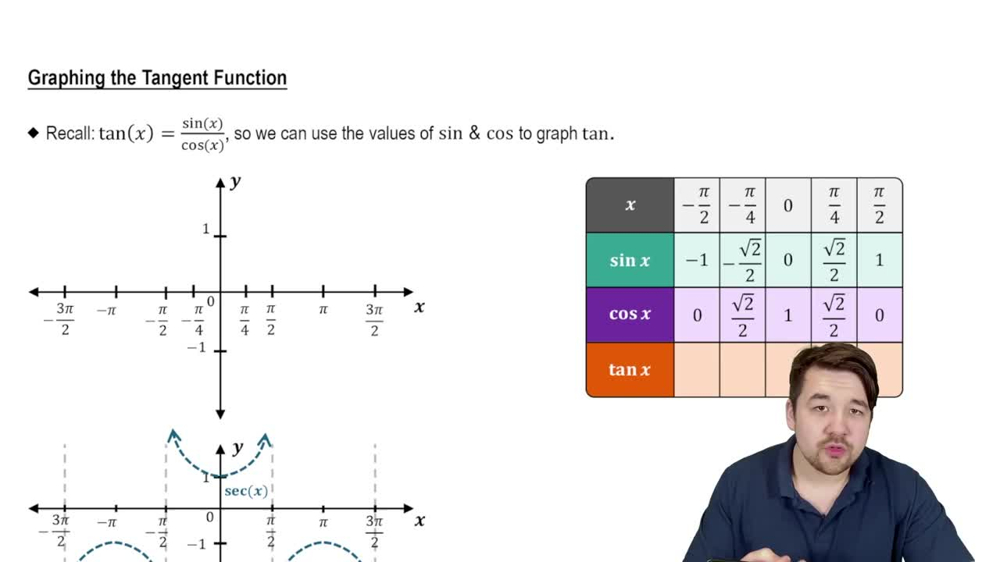
The tangent function, denoted as tan θ, is defined as the ratio of the sine and cosine functions: tan θ = sin θ/cos θ. It can also be expressed in terms of secant as tan θ = √(sec² θ - 1). This relationship allows us to find an expression for tan θ using the given sec θ value.

 Verified step by step guidance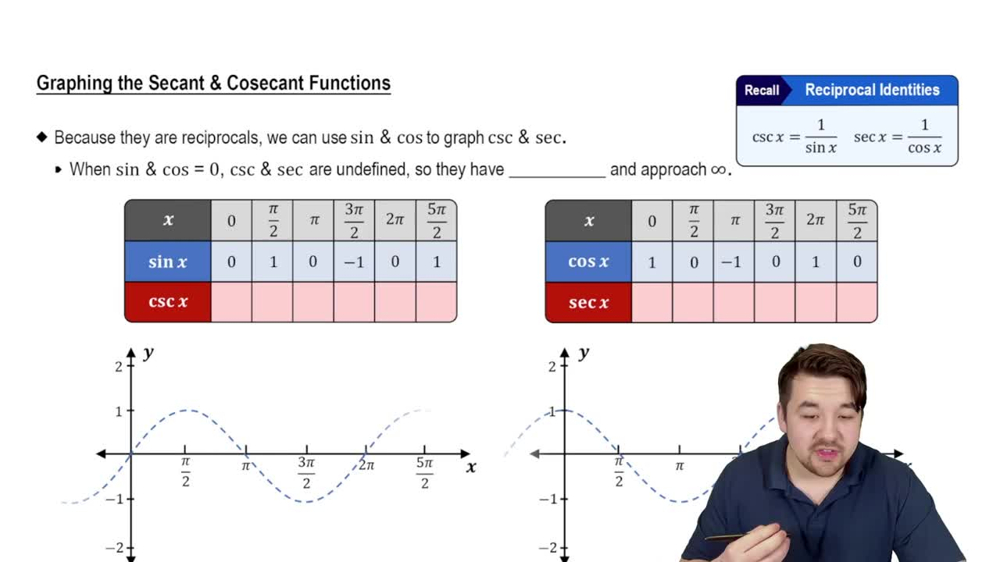
 6:22
6:22