Each expression simplifies to a constant, a single function, or a power of a function. Use fundamental identities to simplify each expression. 1 - 1/sec² x
Verified step by step guidance
1
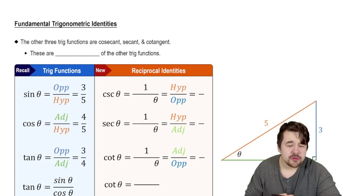
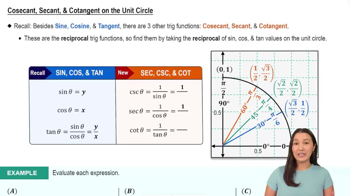
Recognize that \( \sec^2 x \) is the square of the secant function, which is the reciprocal of the cosine function: \( \sec x = \frac{1}{\cos x} \).
Use the identity \( \sec^2 x = 1 + \tan^2 x \) to express \( \sec^2 x \) in terms of tangent.
Substitute \( \sec^2 x = 1 + \tan^2 x \) into the expression: \( 1 - \frac{1}{\sec^2 x} \).
Recognize that the expression simplifies to a constant or a simpler trigonometric function by evaluating the fraction.
Verified video answer for a similar problem:
This video solution was recommended by our tutors as helpful for the problem above
Play a video:
0 Comments
Key Concepts
Here are the essential concepts you must grasp in order to answer the question correctly.
Trigonometric Identities
Trigonometric identities are equations that involve trigonometric functions and are true for all values of the variables involved. Fundamental identities, such as the Pythagorean identities, reciprocal identities, and quotient identities, serve as the foundation for simplifying trigonometric expressions. Understanding these identities is crucial for manipulating and simplifying expressions like the one given.
Reciprocal functions are pairs of trigonometric functions that are defined as the reciprocal of each other. For example, the secant function (sec x) is the reciprocal of the cosine function (cos x), meaning sec x = 1/cos x. Recognizing these relationships allows for easier simplification of expressions involving secant and cosine, as seen in the expression 1 - 1/sec² x.
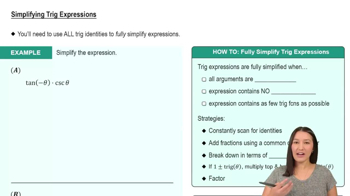
Simplification of expressions in trigonometry involves rewriting complex expressions in a more manageable form, often using identities. This process can include combining like terms, factoring, or substituting equivalent expressions. In the context of the given expression, simplifying 1 - 1/sec² x requires applying the reciprocal identity and recognizing that sec² x relates to cos² x, leading to a clearer expression.