Each expression simplifies to a constant, a single function, or a power of a function. Use fundamental identities to simplify each expression. csc² t - 1
Verified step by step guidance
1
Recognize that the expression \( \csc^2 t - 1 \) can be related to a fundamental trigonometric identity.
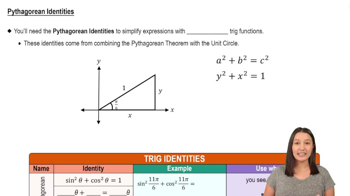
Recall the Pythagorean identity: \( \csc^2 t = 1 + \cot^2 t \).
Substitute \( \csc^2 t \) in the expression with \( 1 + \cot^2 t \) to get \( (1 + \cot^2 t) - 1 \).
Simplify the expression by subtracting 1: \( \cot^2 t \).
Conclude that the simplified expression is \( \cot^2 t \), which is a power of a trigonometric function.
Verified video answer for a similar problem:
This video solution was recommended by our tutors as helpful for the problem above
Play a video:
0 Comments
Key Concepts
Here are the essential concepts you must grasp in order to answer the question correctly.
Cosecant Function
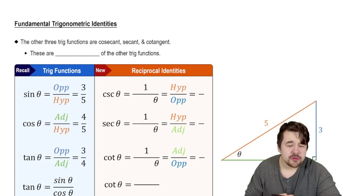
The cosecant function, denoted as csc(t), is the reciprocal of the sine function. It is defined as csc(t) = 1/sin(t). Understanding this function is crucial for simplifying expressions involving csc²(t), as it relates directly to the sine function and its properties.
The Pythagorean identities are fundamental relationships in trigonometry that relate the squares of the sine and cosine functions. One key identity is sin²(t) + cos²(t) = 1. This identity can be rearranged to express csc²(t) in terms of sin²(t), which is essential for simplifying expressions like csc²(t) - 1.
Fundamental trigonometric identities are equations involving trigonometric functions that are true for all values of the variable where the functions are defined. These include reciprocal identities, Pythagorean identities, and co-function identities. Utilizing these identities allows for the simplification of complex trigonometric expressions into more manageable forms.