Graph each function over a one-period interval. See Examples 1–3. y = 2 tan x
Verified step by step guidance
1
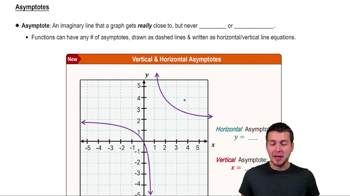
Step 1: Identify the basic properties of the tangent function. The tangent function, \( \tan x \), has a period of \( \pi \) and vertical asymptotes where \( \cos x = 0 \), which occur at \( x = \frac{\pi}{2} + k\pi \) for any integer \( k \).
Step 2: Determine the period of the function \( y = 2 \tan x \). Since the period of \( \tan x \) is \( \pi \), the period of \( 2 \tan x \) remains \( \pi \) because the coefficient 2 only affects the amplitude, not the period.
Step 3: Identify the vertical asymptotes for \( y = 2 \tan x \). The vertical asymptotes occur at \( x = \frac{\pi}{2} + k\pi \). For one period, consider \( x \) values from \( -\frac{\pi}{2} \) to \( \frac{\pi}{2} \).
Step 4: Determine the key points for graphing. The function \( y = 2 \tan x \) will pass through the origin \((0, 0)\) and have points at \( \left(-\frac{\pi}{4}, -2\right) \) and \( \left(\frac{\pi}{4}, 2\right)\) within one period.
Step 5: Sketch the graph. Plot the key points and draw the curve approaching the vertical asymptotes at \( x = -\frac{\pi}{2} \) and \( x = \frac{\pi}{2} \). The graph should show the typical shape of the tangent function, scaled vertically by a factor of 2.
Verified video answer for a similar problem:
This video solution was recommended by our tutors as helpful for the problem above
Play a video:
0 Comments
Key Concepts
Here are the essential concepts you must grasp in order to answer the question correctly.
Periodicity of Trigonometric Functions
Trigonometric functions, such as tangent, are periodic, meaning they repeat their values in regular intervals. For the tangent function, the period is π, indicating that the function's values will repeat every π radians. Understanding periodicity is essential for graphing these functions accurately over specified intervals.
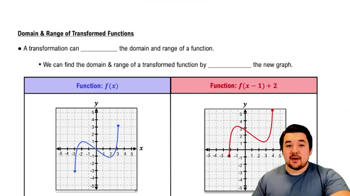
Transformations involve altering the basic shape of a function through vertical and horizontal shifts, stretches, or compressions. In the function y = 2 tan x, the coefficient '2' indicates a vertical stretch, which affects the amplitude of the graph. Recognizing how transformations impact the graph is crucial for accurate representation.
The tangent function has vertical asymptotes where the function is undefined, specifically at odd multiples of π/2 (e.g., π/2, 3π/2). These asymptotes indicate where the graph approaches infinity and are critical for understanding the behavior of the function. Identifying these points is essential for accurately graphing the function over a one-period interval.

 Verified step by step guidance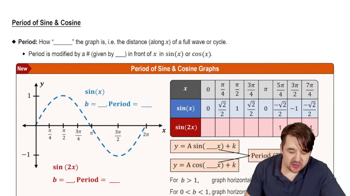
 5:33
5:33