For each function, give the amplitude, period, vertical translation, and phase shift, as applicable. y = (1/2)csc (2x - π/4)
Verified step by step guidance
1
Identify the general form of the cosecant function: \(y = A \csc(Bx - C) + D\), where \(A\) is the amplitude factor, \(B\) affects the period, \(C\) is related to the phase shift, and \(D\) is the vertical translation.
Determine the amplitude: For cosecant functions, amplitude is not typically defined because \(\csc\) can take values from \(-\infty\) to \(-1\) and from \$1$ to \(\infty\). However, the coefficient \(A = \frac{1}{2}\) affects the vertical stretch or compression of the graph.
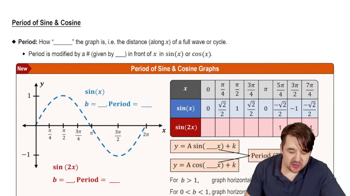
Calculate the period using the formula \(\text{Period} = \frac{2\pi}{|B|}\). Here, \(B = 2\), so substitute to find the period expression.
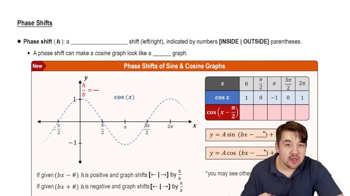
Find the phase shift using the formula \(\text{Phase shift} = \frac{C}{B}\). Given \(C = \frac{\pi}{4}\), substitute and simplify to express the phase shift.
Identify the vertical translation \(D\). Since there is no constant added or subtracted outside the cosecant function, the vertical translation is zero.
Verified video answer for a similar problem:
This video solution was recommended by our tutors as helpful for the problem above
Play a video:
0 Comments
Key Concepts
Here are the essential concepts you must grasp in order to answer the question correctly.
Amplitude of Trigonometric Functions
Amplitude measures the maximum distance a function's value deviates from its midline. For sine and cosine, it is the absolute value of the coefficient before the function. However, for cosecant and secant functions, amplitude is not defined because their values can grow without bound.
The period is the length of one complete cycle of a function. For functions like sine and cosecant, the period is calculated as 2π divided by the coefficient of x inside the function. In this case, with csc(2x - π/4), the period is π, since 2π/2 = π.
Phase shift refers to the horizontal shift of the graph, determined by setting the inside of the function's argument equal to zero and solving for x. Vertical translation is a shift up or down, indicated by a constant added or subtracted outside the function. Here, the phase shift is π/8 to the right, and there is no vertical translation.