In Exercises 13–20, let v be the vector from initial point P₁ to terminal point P₂. Write v in terms of i and j.P₁ = (-1, 7), P₂ = (-7, -7)
Verified step by step guidance
1
insert step 1: Identify the coordinates of the initial point P₁ and the terminal point P₂.
insert step 2: Use the formula for the vector from P₁ to P₂: v = (x₂ - x₁)i + (y₂ - y₁)j.
insert step 3: Substitute the coordinates of P₁ = (-1, 7) and P₂ = (-7, -7) into the formula.
insert step 4: Calculate the difference for the x-components: x₂ - x₁ = -7 - (-1).
insert step 5: Calculate the difference for the y-components: y₂ - y₁ = -7 - 7.
Verified video answer for a similar problem:
This video solution was recommended by our tutors as helpful for the problem above
Video duration:
2m
Play a video:
0 Comments
Key Concepts
Here are the essential concepts you must grasp in order to answer the question correctly.
Vectors
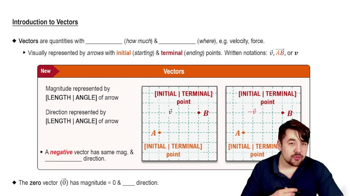
A vector is a mathematical object that has both magnitude and direction. In a two-dimensional space, a vector can be represented as an ordered pair of coordinates, indicating its position relative to a reference point. The vector from point P₁ to point P₂ can be calculated by subtracting the coordinates of P₁ from those of P₂.
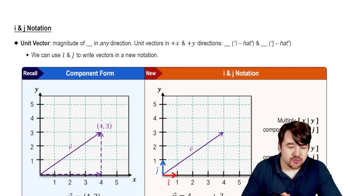
In the Cartesian coordinate system, the unit vectors i and j represent the directions along the x-axis and y-axis, respectively. The vector i corresponds to (1, 0) and j corresponds to (0, 1). Any vector in two-dimensional space can be expressed as a linear combination of these unit vectors, allowing for a clear representation of its components in terms of direction.
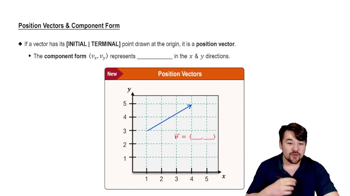
To express a vector in terms of i and j, one must first determine its components. This involves calculating the difference in the x-coordinates and the y-coordinates of the initial and terminal points. For the vector v from P₁ to P₂, the x-component is found by subtracting the x-coordinate of P₁ from that of P₂, and similarly for the y-component, leading to a representation of v as a combination of i and j.