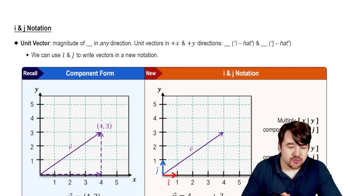
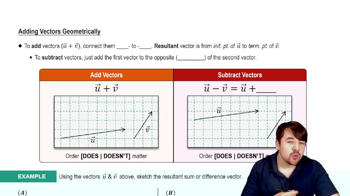
In Exercises 13–20, let v be the vector from initial point P₁ to terminal point P₂. Write v in terms of i and j.P₁ = (-4, -4), P₂ = (6, 2)
Verified step by step guidance
1
Determine the components of the vector \( \mathbf{v} \) by subtracting the coordinates of the initial point \( P_1 \) from the terminal point \( P_2 \).
Calculate the change in the x-direction: \( \Delta x = x_2 - x_1 = 6 - (-4) \).
Calculate the change in the y-direction: \( \Delta y = y_2 - y_1 = 2 - (-4) \).
Express the vector \( \mathbf{v} \) in terms of \( \mathbf{i} \) and \( \mathbf{j} \) using the changes in x and y: \( \mathbf{v} = \Delta x \mathbf{i} + \Delta y \mathbf{j} \).
Substitute the calculated values of \( \Delta x \) and \( \Delta y \) into the expression for \( \mathbf{v} \).
Verified video answer for a similar problem:
This video solution was recommended by our tutors as helpful for the problem above.
Video duration:
2m
Play a video:
0 Comments
Was this helpful?
Key Concepts
Here are the essential concepts you must grasp in order to answer the question correctly.
Vectors
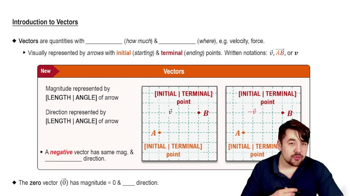
A vector is a mathematical object that has both magnitude and direction. In a two-dimensional space, a vector can be represented as an ordered pair of coordinates, indicating its position relative to a reference point. For example, the vector from point P₁ to P₂ can be expressed as the difference between their coordinates.
In a Cartesian coordinate system, the unit vectors i and j represent the directions along the x-axis and y-axis, respectively. The vector i is typically represented as (1, 0), while j is (0, 1). Any vector in the plane can be expressed as a linear combination of these unit vectors, allowing for a clear representation of its components.
Vector subtraction involves finding the difference between two vectors, which can be visualized as moving from one point to another in the coordinate plane. For the given points P₁ and P₂, the vector v can be calculated by subtracting the coordinates of P₁ from those of P₂, resulting in a new vector that indicates the direction and distance from P₁ to P₂.


 Verified step by step guidance
 03:48
03:48