
Textbook Question
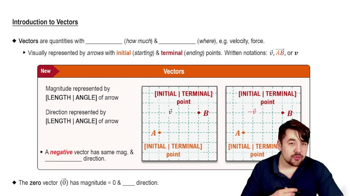
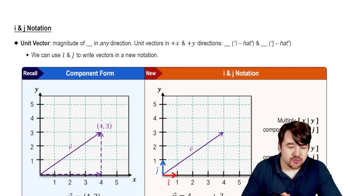
In Exercises 25–26, let v be the vector from initial point P₁ to terminal point P₂. Write v in terms of i and j.
P₁ = (-3, 0), P₂ = (-2, -2)
606
views

 Verified step by step guidance
 03:48
03:48
 06:01
06:01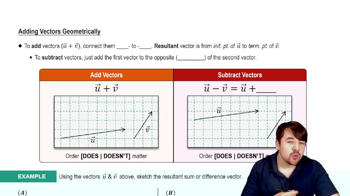 05:29
05:29In Exercises 25–26, let v be the vector from initial point P₁ to terminal point P₂. Write v in terms of i and j.
P₁ = (-3, 0), P₂ = (-2, -2)
In Exercises 21–38, let u = 2i - 5j, v = -3i + 7j, and w = -i - 6j. Find each specified vector or scalar.
v - u
In Exercises 23–32, use the dot product to determine whether v and w are orthogonal.
v = 2i + 8j, w = 4i - j
In Exercises 17–32, two sides and an angle (SSA) of a triangle are given. Determine whether the given measurements produce one triangle, two triangles, or no triangle at all. Solve each triangle that results. Round to the nearest tenth and the nearest degree for sides and angles, respectively.
a = 10, b = 30, A = 150°
In Exercises 17–32, two sides and an angle (SSA) of a triangle are given. Determine whether the given measurements produce one triangle, two triangles, or no triangle at all. Solve each triangle that results. Round to the nearest tenth and the nearest degree for sides and angles, respectively.
a = 30, b = 40, A = 20°
In Exercises 25–30, use Heron's formula to find the area of each triangle. Round to the nearest square unit.
a = 4 feet, b = 4 feet, c = 2 feet