Graph each function over a one-period interval. See Examples 1–3. y = tan 4x
Verified step by step guidance
1
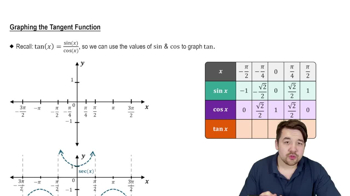
Step 1: Identify the basic properties of the tangent function. The tangent function, \( y = \tan(x) \), has a period of \( \pi \) and vertical asymptotes where the function is undefined.
Step 2: Determine the period of \( y = \tan(4x) \). The period of \( \tan(kx) \) is given by \( \frac{\pi}{k} \). For \( y = \tan(4x) \), the period is \( \frac{\pi}{4} \).
Step 3: Identify the vertical asymptotes. For \( y = \tan(4x) \), the vertical asymptotes occur at \( x = \frac{\pi}{8} + \frac{n\pi}{4} \), where \( n \) is an integer.
Step 4: Determine the x-intercepts. The x-intercepts of \( y = \tan(4x) \) occur at \( x = \frac{n\pi}{4} \), where \( n \) is an integer.
Step 5: Sketch the graph over one period. Plot the x-intercepts and vertical asymptotes, and draw the curve of the tangent function, which increases from negative to positive infinity between each pair of asymptotes.
Verified video answer for a similar problem:
This video solution was recommended by our tutors as helpful for the problem above
Play a video:
0 Comments
Key Concepts
Here are the essential concepts you must grasp in order to answer the question correctly.
Period of Trigonometric Functions
The period of a trigonometric function is the length of one complete cycle of the function. For the tangent function, the standard period is π. However, when the function is modified, such as in y = tan(4x), the period is adjusted by the coefficient of x. In this case, the period becomes π/4, meaning the function will complete one full cycle over this interval.
The tangent function, y = tan(x), has specific characteristics, including vertical asymptotes and points of intersection with the x-axis. The graph of y = tan(4x) will have vertical asymptotes where the function is undefined, specifically at x = (π/8) + (nπ/4) for integers n. Understanding these features is crucial for accurately sketching the graph.
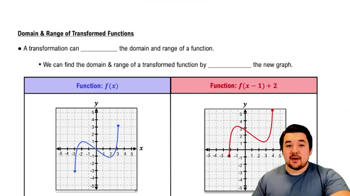
Transformations involve changes to the basic form of a function, affecting its position, shape, or size. In the case of y = tan(4x), the '4' indicates a horizontal compression, which alters the spacing of the function's features, such as its period and asymptotes. Recognizing how transformations impact the graph is essential for accurate representation.

 Verified step by step guidance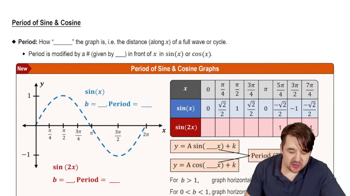
 5:33
5:33