In Exercises 35–60, find the reference angle for each angle. 7𝜋/4
Verified step by step guidance
1
Identify the given angle: \(\frac{7\pi}{4}\) radians.
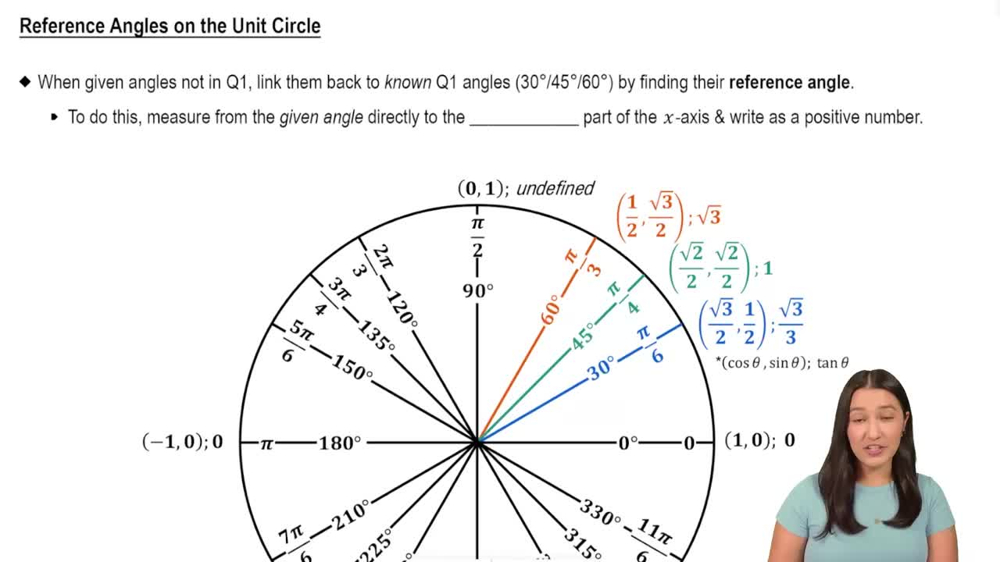
Recall that the reference angle is the acute angle formed between the terminal side of the given angle and the x-axis.
Determine the quadrant in which \(\frac{7\pi}{4}\) lies. Since \(\pi\) is \(4\pi/4\), and \(2\pi\) is \(8\pi/4\), \(\frac{7\pi}{4}\) is between \(\frac{3\pi}{2}\) (\(6\pi/4\)) and \(2\pi\) (\(8\pi/4\)), so it lies in the fourth quadrant.
For angles in the fourth quadrant, the reference angle \(\theta_{ref}\) is calculated as \(\theta_{ref} = 2\pi - \theta\). Substitute \(\theta = \frac{7\pi}{4}\) to get \(\theta_{ref} = 2\pi - \frac{7\pi}{4}\).
Simplify the expression for the reference angle to find its value in radians.
Verified video answer for a similar problem:
This video solution was recommended by our tutors as helpful for the problem above
Video duration:
3m
Play a video:
0 Comments
Key Concepts
Here are the essential concepts you must grasp in order to answer the question correctly.
Reference Angle
A reference angle is the acute angle formed between the terminal side of a given angle and the x-axis. It is always positive and less than or equal to 90°, used to simplify trigonometric calculations by relating any angle to an acute angle.
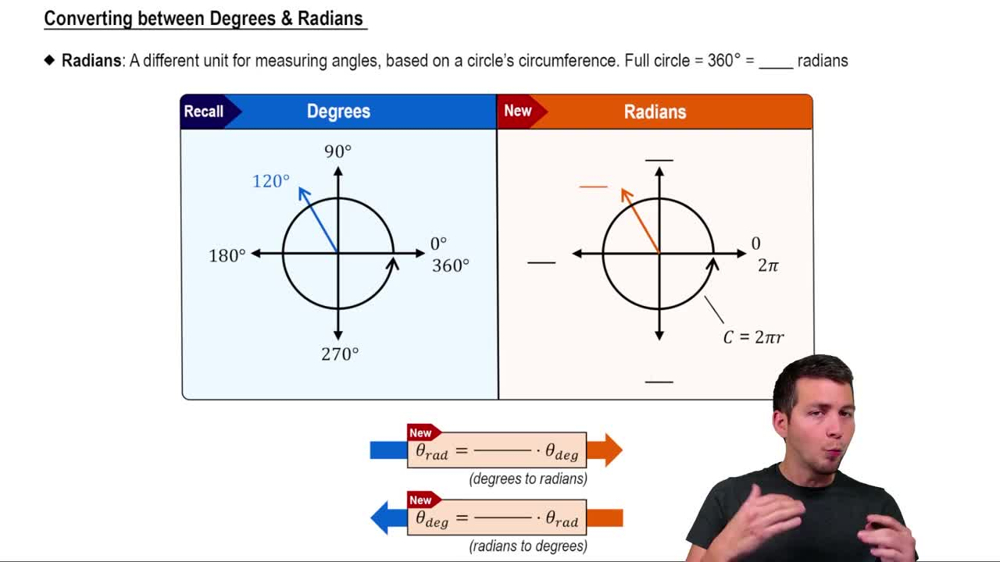
Angles can be measured in radians, where 2𝜋 radians equal 360°. Understanding how to convert and interpret angles in radians is essential for finding reference angles, especially when the given angle exceeds 2𝜋 or is expressed as a fraction of 𝜋.
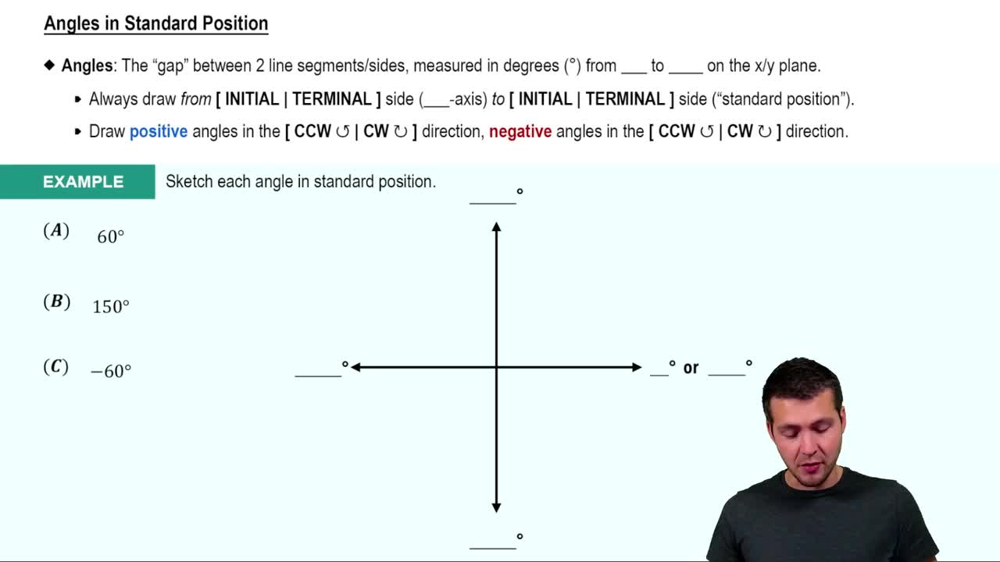
The coordinate plane is divided into four quadrants, each affecting the sign and calculation of reference angles. Knowing which quadrant an angle lies in helps determine how to calculate its reference angle by measuring the distance to the nearest x-axis.

 3:43 minutes
 Verified step by step guidance
 5:31
5:31