Give all six trigonometric function values for each angle θ. Rationalize denominators when applicable. See Examples 5–7. tan θ = ―15/8 , and θ is in quadrant II .
Verified step by step guidance
1
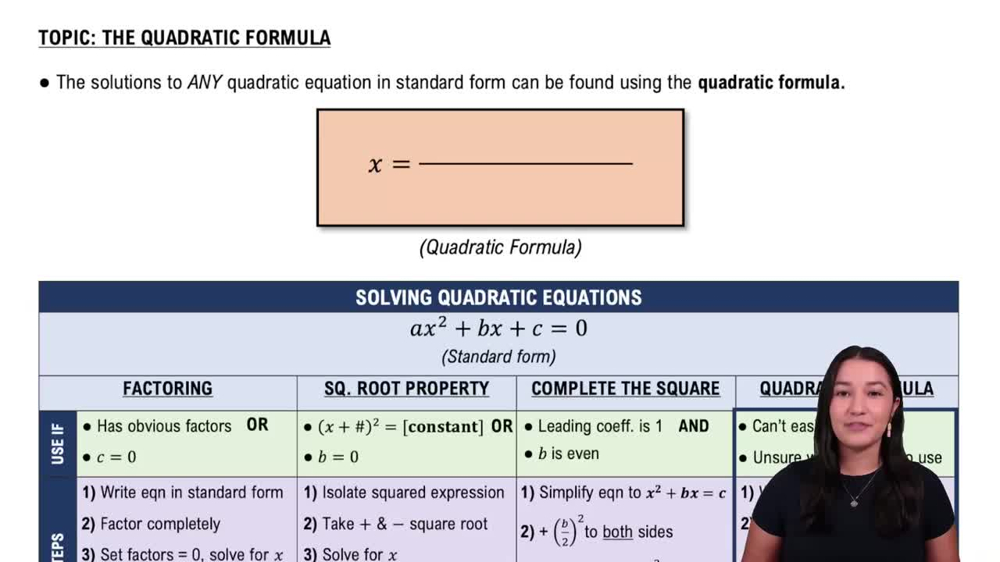
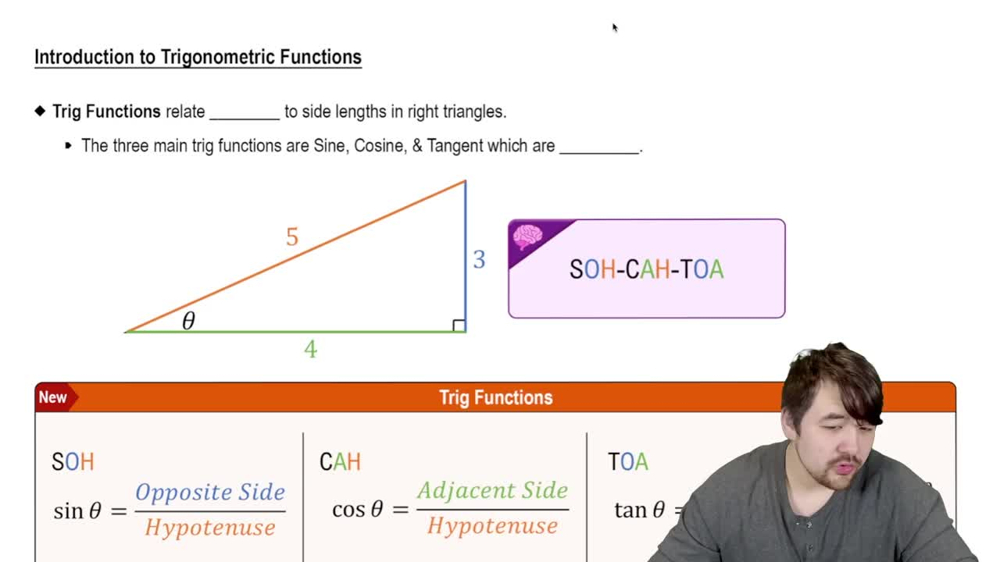
Recall that the six trigonometric functions are sine, cosine, tangent, cosecant, secant, and cotangent, defined as follows: \(\sin \theta = \frac{y}{r}\), \(\cos \theta = \frac{x}{r}\), \(\tan \theta = \frac{y}{x}\), \(\csc \theta = \frac{r}{y}\), \(\sec \theta = \frac{r}{x}\), and \(\cot \theta = \frac{x}{y}\), where \((x, y)\) is a point on the terminal side of angle \(\theta\) and \(r = \sqrt{x^2 + y^2}\).
Given \(\tan \theta = -\frac{15}{8}\) and that \(\theta\) is in quadrant II, determine the signs of \(x\) and \(y\). In quadrant II, \(x\) is negative and \(y\) is positive. Since \(\tan \theta = \frac{y}{x}\) is negative, this matches the given ratio with \(y = 15\) and \(x = -8\) (choosing values consistent with the signs in quadrant II).
Calculate the hypotenuse \(r\) using the Pythagorean theorem: \(r = \sqrt{x^2 + y^2} = \sqrt{(-8)^2 + 15^2} = \sqrt{64 + 225}\).
Find \(\sin \theta\) and \(\cos \theta\) using the definitions: \(\sin \theta = \frac{y}{r}\) and \(\cos \theta = \frac{x}{r}\). Substitute the values of \(x\), \(y\), and \(r\).
Use the values of \(\sin \theta\) and \(\cos \theta\) to find the remaining functions: \(\tan \theta = \frac{\sin \theta}{\cos \theta}\), \(\csc \theta = \frac{1}{\sin \theta}\), \(\sec \theta = \frac{1}{\cos \theta}\), and \(\cot \theta = \frac{1}{\tan \theta}\). Rationalize denominators where necessary.
Verified video answer for a similar problem:
This video solution was recommended by our tutors as helpful for the problem above
Video duration:
5m
Play a video:
0 Comments
Key Concepts
Here are the essential concepts you must grasp in order to answer the question correctly.
Trigonometric Functions and Their Relationships
The six trigonometric functions—sine, cosine, tangent, cosecant, secant, and cotangent—are interrelated ratios based on a right triangle or the unit circle. Knowing one function value, such as tangent, allows calculation of others using identities like sin²θ + cos²θ = 1 and tan θ = sin θ / cos θ.
The sign of trigonometric functions depends on the quadrant where the angle lies. In quadrant II, sine is positive, while cosine and tangent are negative. This knowledge helps determine the correct signs of all six functions once one value and the quadrant are known.
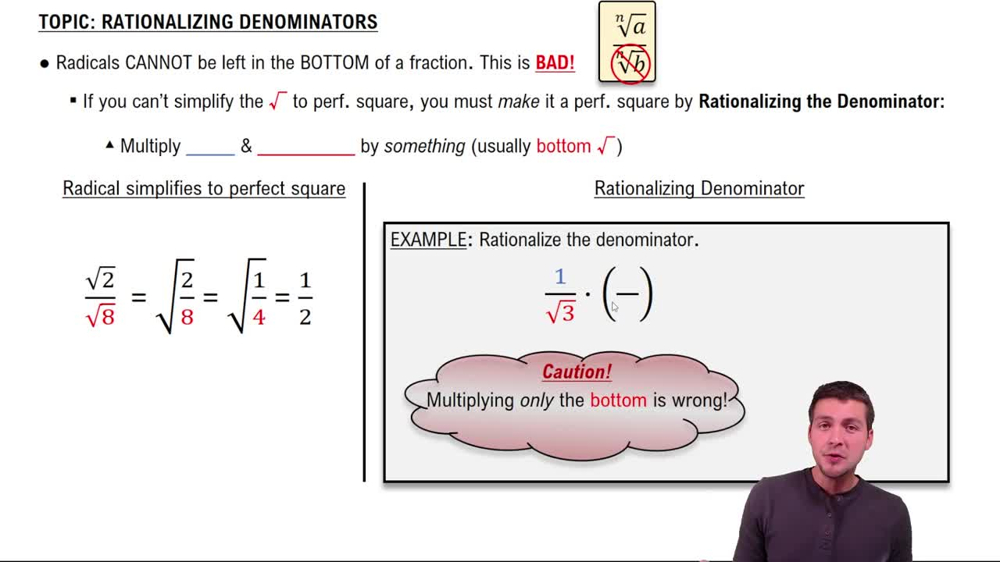
Rationalizing denominators involves eliminating radicals or complex expressions from the denominator of a fraction. This is done by multiplying numerator and denominator by a suitable expression, ensuring the final trigonometric values are presented in a simplified, standard form.

 5:17 minutes
 Verified step by step guidance
 6:04
6:04