Step 1: Identify the function type. The function \( f(x) = \sqrt{-x} \) is a square root function, but it involves a negative sign inside the square root.
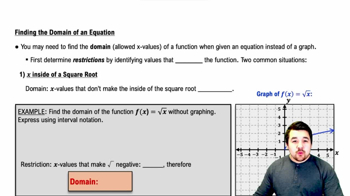
Step 2: Determine the domain of the function. Since the square root function is only defined for non-negative numbers, \( -x \geq 0 \) implies \( x \leq 0 \). Therefore, the domain of \( f(x) \) is all real numbers less than or equal to zero.
Step 3: Analyze the range of the function. The square root function outputs non-negative values, so \( f(x) \geq 0 \).
Step 4: Consider the transformation. The function \( f(x) = \sqrt{-x} \) can be seen as a reflection of the basic square root function \( \sqrt{x} \) across the y-axis.
Step 5: Sketch the graph. Start by plotting key points such as \( (0, 0) \) and \( (-1, 1) \), and draw a smooth curve that reflects the shape of the square root function, extending to the left along the x-axis.
Verified video answer for a similar problem:
This video solution was recommended by our tutors as helpful for the problem above
Video duration:
2m
Play a video:
0 Comments
Key Concepts
Here are the essential concepts you must grasp in order to answer the question correctly.
Domain of a Function
The domain of a function refers to the set of all possible input values (x-values) for which the function is defined. For the function ƒ(x) = √-x, the expression under the square root must be non-negative, meaning -x ≥ 0 or x ≤ 0. This indicates that the function is only defined for x-values less than or equal to zero.
Graphing square root functions involves plotting points based on the function's output for given inputs. For ƒ(x) = √-x, the graph will consist of points where x is non-positive, and the output will be real numbers. The graph will start at the origin (0,0) and extend leftward, forming a curve that rises as x approaches zero.
Transformations of functions involve shifting, reflecting, stretching, or compressing the graph of a function. In the case of ƒ(x) = √-x, the negative sign indicates a reflection across the y-axis compared to the standard square root function ƒ(x) = √x. Understanding these transformations helps in accurately sketching the graph based on the original function.