Solve each problem. See Examples 3 and 4. Height of an Antenna A scanner antenna is on top of the center of a house. The angle of elevation from a point 28.0 m from the center of the house to the top of the antenna is 27°10', and the angle of elevation to the bottom of the antenna is 18°10'. Find the height of the antenna.
Table of contents
- 0. Review of College Algebra4h 45m
- 1. Measuring Angles40m
- 2. Trigonometric Functions on Right Triangles2h 5m
- 3. Unit Circle1h 19m
- 4. Graphing Trigonometric Functions1h 19m
- 5. Inverse Trigonometric Functions and Basic Trigonometric Equations1h 41m
- 6. Trigonometric Identities and More Equations2h 34m
- 7. Non-Right Triangles1h 38m
- 8. Vectors2h 25m
- 9. Polar Equations2h 5m
- 10. Parametric Equations1h 6m
- 11. Graphing Complex Numbers1h 7m
2. Trigonometric Functions on Right Triangles
Trigonometric Functions on Right Triangles
Problem 2.5.38
Textbook Question
Solve each problem. See Examples 3 and 4. Distance through a Tunnel A tunnel is to be built from point A to point B. Both A and B are visible from C. If AC is 1.4923 mi and BC is 1.0837 mi, and if C is 90°, find the measures of angles A and B.
Verified step by step guidance1
Identify the triangle formed by points A, B, and C, where C is the vertex with a right angle (90°). Since C is 90°, triangle ABC is a right triangle with AC and BC as the legs, and AB as the hypotenuse.
Recall that in a right triangle, the sum of the angles is 180°, and since angle C is 90°, the other two angles A and B must add up to 90°.
Use the definitions of sine, cosine, or tangent to find the measures of angles A and B. For example, to find angle A, use the tangent function: \(\tan(A) = \frac{\text{opposite side}}{\text{adjacent side}} = \frac{BC}{AC}\).
Calculate angle A by taking the inverse tangent (arctan) of the ratio \(\frac{BC}{AC}\): \(A = \arctan\left(\frac{BC}{AC}\right)\).
Find angle B by subtracting angle A from 90°: \(B = 90^\circ - A\).
Verified video answer for a similar problem:This video solution was recommended by our tutors as helpful for the problem above
Video duration:
5mPlay a video:
0 Comments
Key Concepts
Here are the essential concepts you must grasp in order to answer the question correctly.
Right Triangle Properties
A right triangle has one angle measuring 90°, which allows the use of specific trigonometric relationships. In this problem, angle C is 90°, making triangle ABC a right triangle. This simplifies calculations since the sum of the other two angles must be 90°, and the Pythagorean theorem applies.
Recommended video:
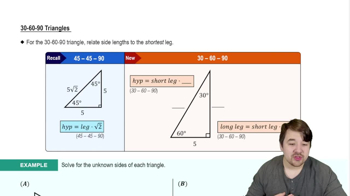
30-60-90 Triangles
Trigonometric Ratios (Sine, Cosine, Tangent)
Trigonometric ratios relate the angles of a right triangle to the lengths of its sides. For example, sine of an angle is the ratio of the opposite side to the hypotenuse. Using the given side lengths AC and BC, these ratios help find the unknown angles A and B.
Recommended video:
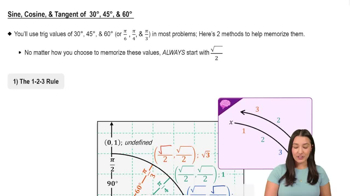
Sine, Cosine, & Tangent of 30°, 45°, & 60°
Angle Sum Property of Triangles
The sum of the interior angles in any triangle is always 180°. Since angle C is 90°, angles A and B must add up to 90°. This property allows finding one angle if the other is known, ensuring the solution is consistent.
Recommended video:
Sum and Difference of Tangent
Related Videos
Related Practice
Textbook Question
804
views