Graph each function. See Examples 6–8.ƒ(x) = √x + 2
Verified step by step guidance
1
Identify the basic function: The function \( f(x) = \sqrt{x} \) is a square root function, which typically has a domain of \( x \geq 0 \) and a range of \( y \geq 0 \).
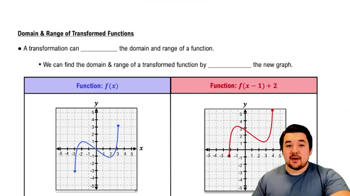
Determine the transformation: The function \( f(x) = \sqrt{x} + 2 \) is a vertical shift of the basic square root function \( \sqrt{x} \) upwards by 2 units.
Find the domain: Since the square root function is defined for \( x \geq 0 \), the domain of \( f(x) = \sqrt{x} + 2 \) is also \( x \geq 0 \).
Find the range: The range of the basic function \( \sqrt{x} \) is \( y \geq 0 \). After the vertical shift, the range of \( f(x) = \sqrt{x} + 2 \) becomes \( y \geq 2 \).
Sketch the graph: Start by plotting the point (0, 2) since \( f(0) = \sqrt{0} + 2 = 2 \). Then, plot additional points by choosing values of \( x \) (e.g., 1, 4, 9) and calculating \( f(x) \). Connect these points with a smooth curve, keeping in mind the shape of the square root function.
Verified video answer for a similar problem:
This video solution was recommended by our tutors as helpful for the problem above
Video duration:
2m
Play a video:
0 Comments
Key Concepts
Here are the essential concepts you must grasp in order to answer the question correctly.
Graphing Functions
Graphing functions involves plotting points on a coordinate plane to visualize the relationship between the input (x) and output (ƒ(x)). Understanding how to identify key features such as intercepts, domain, and range is essential for accurately representing the function. For the function ƒ(x) = √x + 2, recognizing that it is a transformation of the square root function will help in sketching its graph.
The square root function, denoted as √x, is defined for non-negative values of x and produces non-negative outputs. Its graph starts at the origin (0,0) and increases gradually, forming a curve that approaches infinity as x increases. In the function ƒ(x) = √x + 2, the '+2' indicates a vertical shift of the graph upwards by 2 units, affecting the y-values of all points on the graph.
Transformations of functions involve shifting, stretching, or reflecting the graph of a function. In the case of ƒ(x) = √x + 2, the '+2' represents a vertical shift, which moves the entire graph of the square root function up by 2 units. Understanding these transformations is crucial for accurately graphing functions and predicting how changes in the equation affect the graph's appearance.

 2:23 minutes
 Verified step by step guidance
 5:53
5:53