Graph each function. See Examples 6–8. ƒ(x) = √x + 2
Verified step by step guidance
1
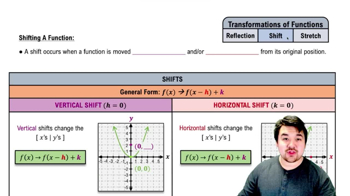
Identify the function to be graphed: \(f(x) = \sqrt{x} + 2\). This means the graph is the square root function shifted vertically upward by 2 units.
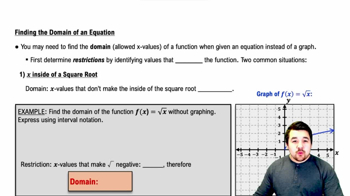
Determine the domain of the function. Since the square root function \(\sqrt{x}\) is defined only for \(x \geq 0\), the domain of \(f(x)\) is also \(x \geq 0\).
Find key points to plot by substituting values of \(x\) within the domain. For example, calculate \(f(0) = \sqrt{0} + 2\), \(f(1) = \sqrt{1} + 2\), and \(f(4) = \sqrt{4} + 2\) to get points \((0, 2)\), \((1, 3)\), and \((4, 4)\).
Plot these points on the coordinate plane. Since the square root function increases slowly, the graph will start at \((0, 2)\) and rise gradually to the right.
Draw a smooth curve through the plotted points starting at \((0, 2)\) and increasing to the right, reflecting the shape of the square root function shifted up by 2 units.
Verified video answer for a similar problem:
This video solution was recommended by our tutors as helpful for the problem above
Video duration:
2m
Play a video:
0 Comments
Key Concepts
Here are the essential concepts you must grasp in order to answer the question correctly.
Square Root Function
The square root function, denoted as √x, outputs the non-negative value whose square is x. It is defined only for x ≥ 0 in the real number system, resulting in a graph starting at the origin and increasing gradually. Understanding its domain and shape is essential for graphing transformations.
Adding a constant inside the function's argument, such as √(x + 2), shifts the graph horizontally. Specifically, √(x + 2) shifts the basic square root graph 2 units to the left, changing the domain to x ≥ -2. Recognizing this shift helps in accurately plotting the function.
The domain is the set of all input values for which the function is defined. For √(x + 2), the expression inside the root must be non-negative, so x + 2 ≥ 0, meaning x ≥ -2. Identifying the domain ensures the graph is drawn only where the function exists.

 2:23 minutes
 Verified step by step guidance
 2:20
2:20