Rationalize each denominator. See Example 8. 18 —— √27
Verified step by step guidance
1
Identify the expression to rationalize: \(\frac{18}{\sqrt{27}}\).
Simplify the square root in the denominator if possible. Since \(\sqrt{27} = \sqrt{9 \times 3} = \sqrt{9} \times \sqrt{3} = 3\sqrt{3}\), rewrite the expression as \(\frac{18}{3\sqrt{3}}\).
Simplify the fraction by dividing the numerator and denominator by 3: \(\frac{18}{3\sqrt{3}} = \frac{6}{\sqrt{3}}\).
To rationalize the denominator, multiply both numerator and denominator by \(\sqrt{3}\) to eliminate the square root in the denominator: \(\frac{6}{\sqrt{3}} \times \frac{\sqrt{3}}{\sqrt{3}}\).
Multiply the numerators and denominators: numerator becomes \(6 \times \sqrt{3}\), denominator becomes \(\sqrt{3} \times \sqrt{3} = 3\). The expression is now \(\frac{6\sqrt{3}}{3}\). You can simplify this further by dividing numerator and denominator by 3.
Verified video answer for a similar problem:
This video solution was recommended by our tutors as helpful for the problem above
Video duration:
4m
Play a video:
0 Comments
Key Concepts
Here are the essential concepts you must grasp in order to answer the question correctly.
Simplifying Radicals
Simplifying radicals involves expressing the radicand as a product of perfect squares and other factors to rewrite the square root in simplest form. For example, √27 can be simplified to 3√3 because 27 = 9 × 3 and √9 = 3.
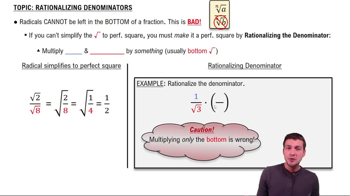
Rationalizing the denominator means eliminating any radicals from the denominator of a fraction by multiplying numerator and denominator by a suitable radical expression. This process makes the denominator a rational number, which is often preferred in final answers.
The properties of square roots, such as √a × √b = √(a×b) and (√a)² = a, are essential for manipulating and simplifying expressions involving radicals. These properties allow for the combination, separation, and simplification of square root terms.

 4:06 minutes
 Verified step by step guidance

 6:36
6:36