Simplify the denominator using the difference of squares formula: \((a + b)(a - b) = a^2 - b^2\), where \(a = 4\) and \(b = \sqrt{5}\).
Simplify the numerator by distributing: \(3 \times (4 - \sqrt{5})\).
Verified video answer for a similar problem:
This video solution was recommended by our tutors as helpful for the problem above
Video duration:
4m
Play a video:
0 Comments
Key Concepts
Here are the essential concepts you must grasp in order to answer the question correctly.
Rationalizing the Denominator
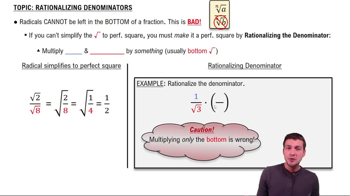
Rationalizing the denominator involves eliminating any irrational numbers from the denominator of a fraction. This is typically achieved by multiplying both the numerator and the denominator by a suitable expression that will result in a rational number in the denominator. For example, if the denominator contains a square root, you can multiply by the same square root to simplify the expression.
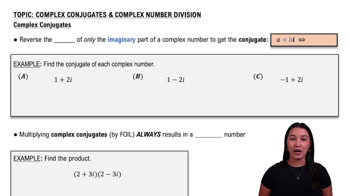
The conjugate of a binomial expression is formed by changing the sign between its two terms. For instance, the conjugate of (a + b) is (a - b). When rationalizing denominators that contain square roots, multiplying by the conjugate can help eliminate the square root, leading to a simpler expression. This technique is particularly useful when the denominator is a sum or difference involving a square root.
Simplifying radicals involves reducing a square root or other root to its simplest form. This can include factoring out perfect squares from under the radical sign or rewriting the expression in a way that minimizes the radical's complexity. Understanding how to simplify radicals is essential for effectively rationalizing denominators and ensuring that the final expression is in its simplest form.

 4:05 minutes
 Verified step by step guidance
 2:58
2:58