Rationalize each denominator. See Example 8. 12—— √72
Verified step by step guidance
1
Identify the denominator that needs to be rationalized: \( \sqrt{72} \).
Express \( \sqrt{72} \) in terms of its prime factors: \( \sqrt{72} = \sqrt{36 \times 2} = \sqrt{36} \times \sqrt{2} = 6\sqrt{2} \).
Multiply both the numerator and the denominator by \( \sqrt{2} \) to rationalize the denominator: \( \frac{12}{6\sqrt{2}} \times \frac{\sqrt{2}}{\sqrt{2}} \).
Simplify the expression: The denominator becomes \( 6 \times 2 = 12 \) and the numerator becomes \( 12\sqrt{2} \).
Simplify the fraction: \( \frac{12\sqrt{2}}{12} = \sqrt{2} \).
Verified video answer for a similar problem:
This video solution was recommended by our tutors as helpful for the problem above
Video duration:
3m
Play a video:
0 Comments
Key Concepts
Here are the essential concepts you must grasp in order to answer the question correctly.
Rationalizing the Denominator
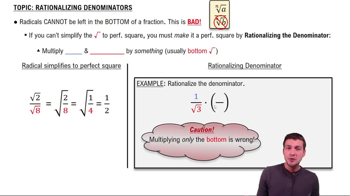
Rationalizing the denominator involves rewriting a fraction so that the denominator is a rational number. This is often done by multiplying both the numerator and the denominator by a suitable expression that eliminates any irrational numbers, such as square roots. The goal is to simplify the expression while maintaining its value.
A square root of a number is a value that, when multiplied by itself, gives the original number. For example, the square root of 72 can be simplified to 6√2, since 72 = 36 × 2 and √36 = 6. Understanding how to simplify square roots is essential for rationalizing denominators effectively.
When dealing with expressions that contain square roots, multiplying by the conjugate can be a useful technique. The conjugate of a binomial expression is formed by changing the sign between two terms. This method is particularly helpful when the denominator is a binomial involving square roots, as it can eliminate the irrational part when multiplied.

 3:41 minutes
 Verified step by step guidance
 2:58
2:58