Determine whether each statement is possible or impossible. See Example 4. tan θ = 0.93
Verified step by step guidance
1
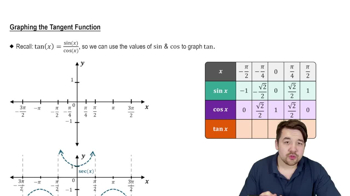
Recall that the tangent function, \( \tan \theta \), is defined as the ratio of the opposite side to the adjacent side in a right triangle, or \( \tan \theta = \frac{\sin \theta}{\cos \theta} \).
Understand that the range of the tangent function is all real numbers, meaning \( \tan \theta \) can take any real value.
Since 0.93 is a real number, it falls within the range of possible values for \( \tan \theta \).
Therefore, the statement \( \tan \theta = 0.93 \) is possible.
Conclude that there exists an angle \( \theta \) for which \( \tan \theta = 0.93 \).
Verified video answer for a similar problem:
This video solution was recommended by our tutors as helpful for the problem above
Video duration:
1m
Play a video:
0 Comments
Key Concepts
Here are the essential concepts you must grasp in order to answer the question correctly.
Tangent Function
The tangent function, denoted as tan(θ), is a fundamental trigonometric function defined as the ratio of the opposite side to the adjacent side in a right triangle. It can also be expressed as tan(θ) = sin(θ) / cos(θ). Understanding this function is crucial for determining the possible values of θ based on the given tangent value.
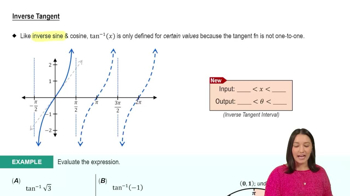
The range of the tangent function is all real numbers, meaning that for any real number input, there exists a corresponding output. This characteristic implies that any value, including 0.93, can be achieved by the tangent function, making it possible to find an angle θ that satisfies tan(θ) = 0.93.
The inverse tangent function, or arctan(θ), is used to find an angle when the tangent value is known. For example, if tan(θ) = 0.93, then θ can be calculated using θ = arctan(0.93). This function is essential for determining specific angles corresponding to given tangent values.