Determine whether each statement is possible or impossible. See Example 4. tan θ = 0.93
Verified step by step guidance
1
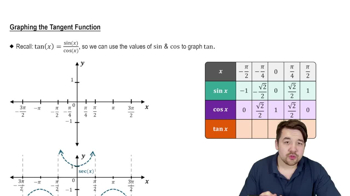
Recall that the tangent function, \(\tan \theta\), is defined as the ratio of the sine and cosine functions: \(\tan \theta = \frac{\sin \theta}{\cos \theta}\).
Understand the range of the tangent function: \(\tan \theta\) can take any real value from \(-\infty\) to \(+\infty\), meaning it is not limited to values between -1 and 1 like sine and cosine.
Since \(\tan \theta = 0.93\) is a positive real number, check if this value lies within the possible range of tangent values. Because tangent can be any real number, 0.93 is within the possible range.
Conclude that there exists an angle \(\theta\) such that \(\tan \theta = 0.93\), so the statement is possible.
Optionally, to find such an angle \(\theta\), you would use the inverse tangent function: \(\theta = \tan^{-1}(0.93)\), which gives the principal value of the angle.
Verified video answer for a similar problem:
This video solution was recommended by our tutors as helpful for the problem above
Video duration:
1m
Play a video:
0 Comments
Key Concepts
Here are the essential concepts you must grasp in order to answer the question correctly.
Definition of the Tangent Function
The tangent of an angle θ in a right triangle is the ratio of the length of the opposite side to the adjacent side. It can also be defined as tan θ = sin θ / cos θ, and its values can range from negative to positive infinity, depending on the angle.
The tangent function can take any real number value, meaning tan θ = 0.93 is possible. Since tangent is periodic with period π, multiple angles can have the same tangent value, and no restrictions prevent tan θ from being 0.93.
To find θ when tan θ = 0.93, use the inverse tangent function (arctan or tan⁻¹). This yields a principal value, and additional solutions can be found by adding integer multiples of π, reflecting the periodic nature of tangent.