Find a calculator approximation to four decimal places for each circular function value. See Example 3. csc (―9.4946)
Verified step by step guidance
1
Recall that the cosecant function is the reciprocal of the sine function. So, \( \csc(\theta) = \frac{1}{\sin(\theta)} \).
Identify the angle given: \( \theta = -9.4946 \) radians. Since the angle is in radians, ensure your calculator is set to radian mode.
Calculate \( \sin(-9.4946) \) using your calculator or a computational tool.
Find the reciprocal of the sine value calculated in the previous step to get \( \csc(-9.4946) = \frac{1}{\sin(-9.4946)} \).
Round the result to four decimal places to obtain the final approximation.
Verified video answer for a similar problem:
This video solution was recommended by our tutors as helpful for the problem above
Play a video:
0 Comments
Key Concepts
Here are the essential concepts you must grasp in order to answer the question correctly.
Circular Functions and Their Definitions
Circular functions, such as sine, cosine, and cosecant, relate angles to ratios of sides in a right triangle or coordinates on the unit circle. Specifically, cosecant (csc) is the reciprocal of sine, defined as csc(θ) = 1/sin(θ). Understanding this relationship is essential for evaluating csc at any angle.
Evaluating Trigonometric Functions at Negative Angles
Trigonometric functions have specific properties when dealing with negative angles. For sine, sin(−θ) = −sin(θ), which affects the value of cosecant since it depends on sine. Recognizing how negative angles influence function values helps in correctly computing csc(−9.4946).
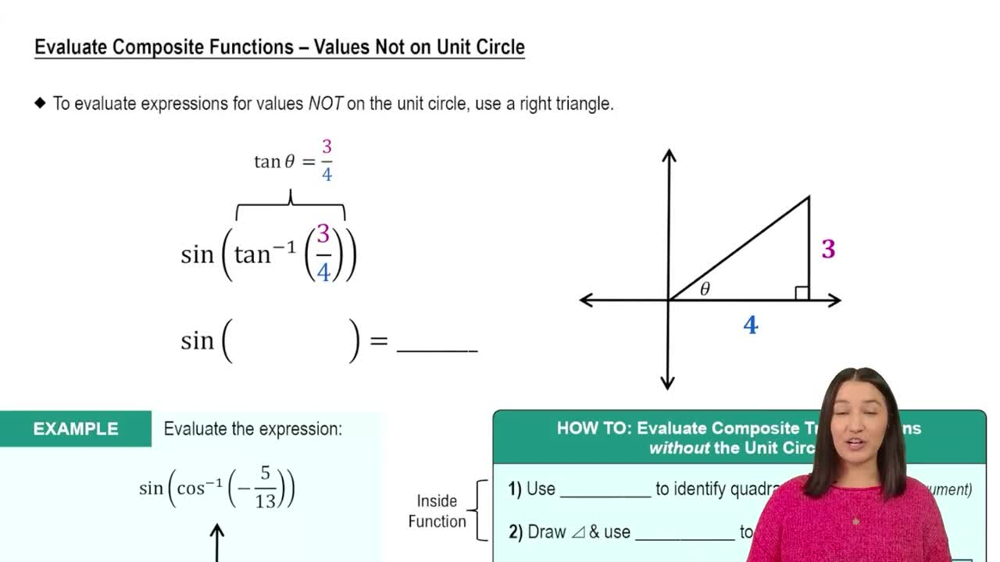
Evaluate Composite Functions - Values Not on Unit Circle
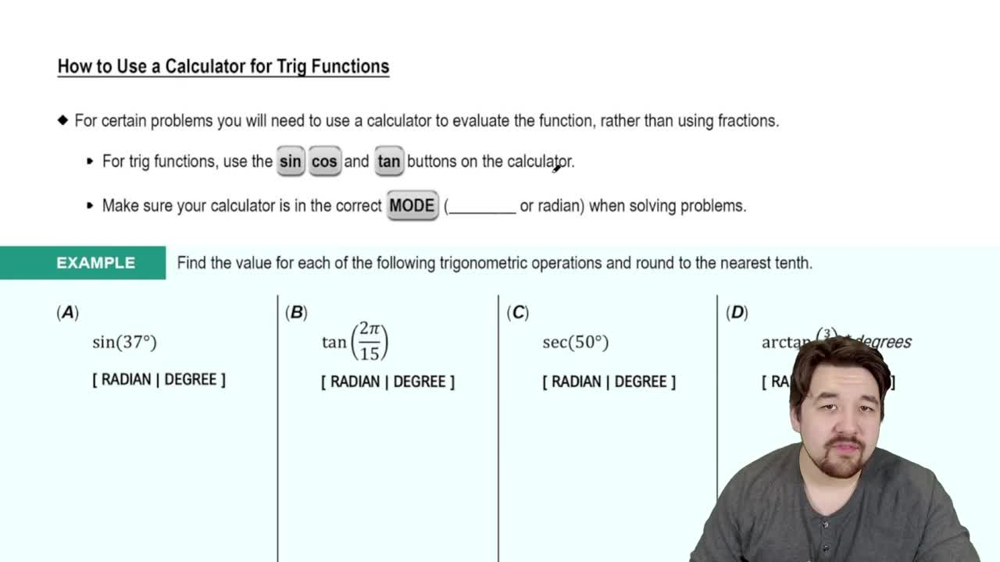
Using Calculators for Approximation and Radian Mode
Calculators can approximate trigonometric values to desired decimal places, but the angle mode (degrees or radians) must be set correctly. Since the angle −9.4946 is likely in radians, the calculator should be in radian mode to get an accurate approximation of csc(−9.4946).

 Verified step by step guidance
 5:57
5:57