Ch. 3 - Radian Measure and The Unit Circle
Lial - Trigonometry 12th Edition
Lial12th EditionTrigonometryISBN: 9780136552161Not the one you use?Change textbook
Chapter 4, Problem 35

Find a calculator approximation to four decimal places for each circular function value. See Example 3. cos (-1.1519)

Verified step by step guidance
1
Recognize that the problem asks for the value of the cosine function at the angle \(-1.1519\) radians. The cosine function is even, meaning \(\cos(-x) = \cos(x)\), so you can work with the positive angle \(1.1519\) radians if you prefer.
Recall that the cosine function gives the horizontal coordinate of a point on the unit circle corresponding to the given angle measured in radians.
Use a scientific calculator or a calculator app that supports trigonometric functions in radian mode. Make sure the calculator is set to radians, not degrees.
Input the angle \(-1.1519\) (or \(1.1519\)) into the cosine function on the calculator: calculate \(\cos(-1.1519)\).
Round the result to four decimal places to get the final approximation.

Verified video answer for a similar problem:

This video solution was recommended by our tutors as helpful for the problem above.
Was this helpful?

Key Concepts

Here are the essential concepts you must grasp in order to answer the question correctly.

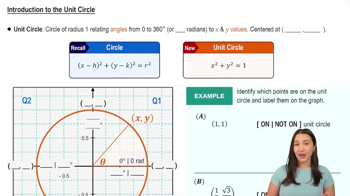
Circular Functions and the Unit Circle

Circular functions like cosine are defined using the unit circle, where the angle corresponds to a point on the circle. The cosine of an angle is the x-coordinate of that point, allowing us to interpret cosine values geometrically for any real angle, including negative angles.
Recommended video:
06:11
Introduction to the Unit Circle

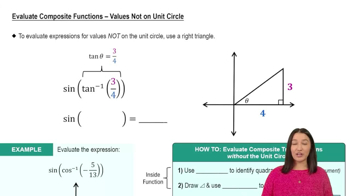
Evaluating Trigonometric Functions for Negative Angles

Negative angles represent clockwise rotation from the positive x-axis. The cosine function is even, meaning cos(-θ) = cos(θ), so the cosine value for a negative angle equals that of its positive counterpart, simplifying calculations and understanding.
Recommended video:
7:28
Evaluate Composite Functions - Values Not on Unit Circle

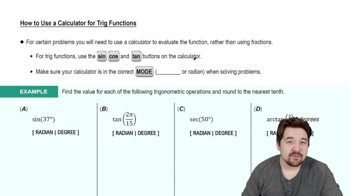
Using Calculators for Trigonometric Approximations

Calculators can approximate trigonometric values to a desired decimal precision. Ensure the calculator is set to the correct mode (radians or degrees) matching the angle's unit, then compute the cosine and round the result to four decimal places as required.
Recommended video:
4:45
How to Use a Calculator for Trig Functions