
Ch. 3 - Radian Measure and The Unit Circle
Lial - Trigonometry 12th Edition
Lial12th EditionTrigonometryISBN: 9780136552161Not the one you use?Change textbook
Chapter 4, Problem 43

Find a calculator approximation to four decimal places for each circular function value. See Example 3.
cot 6.0301

Verified step by step guidance
1
Recall that the cotangent function is the reciprocal of the tangent function. So, \( \cot x = \frac{1}{\tan x} \).
Identify the angle given: \( x = 6.0301 \) radians. Since this is in radians, ensure your calculator is set to radian mode before calculating.
Calculate \( \tan(6.0301) \) using your calculator.
Find the reciprocal of the value obtained in the previous step to get \( \cot(6.0301) = \frac{1}{\tan(6.0301)} \).
Round the result to four decimal places to get the final approximation.

Verified video answer for a similar problem:

This video solution was recommended by our tutors as helpful for the problem above.
Was this helpful?

Key Concepts

Here are the essential concepts you must grasp in order to answer the question correctly.

Circular Functions

Circular functions, also known as trigonometric functions, relate angles to ratios of sides in a right triangle or coordinates on the unit circle. They include sine, cosine, tangent, and their reciprocals such as cotangent. Understanding these functions helps in evaluating values for any given angle.
Recommended video:
5:57
Graphs of Common Functions

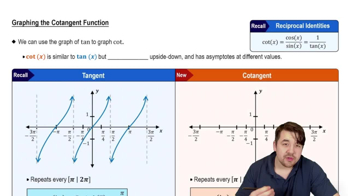
Cotangent Function

The cotangent function is the reciprocal of the tangent function, defined as cot(θ) = 1/tan(θ) or cot(θ) = cos(θ)/sin(θ). It is important to know how to compute cotangent values, especially for angles not commonly found on standard unit circle tables, often requiring calculator use.
Recommended video:
5:37
Introduction to Cotangent Graph

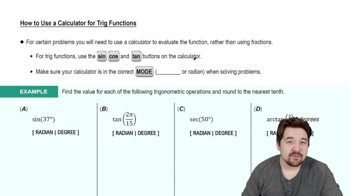
Calculator Approximation and Rounding

Using a scientific calculator to find trigonometric values involves inputting the angle in the correct mode (radians or degrees) and then rounding the result to the desired decimal places. For this problem, the angle is likely in radians, and the answer must be rounded to four decimal places for precision.
Recommended video:
4:45
How to Use a Calculator for Trig Functions