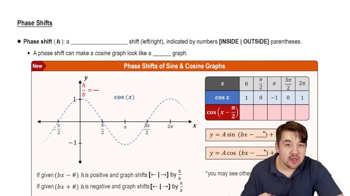
Identify the basic function: The function given is \( y = \sec(x + \frac{\pi}{4}) \). The secant function, \( \sec(x) \), is the reciprocal of the cosine function, \( \sec(x) = \frac{1}{\cos(x)} \).
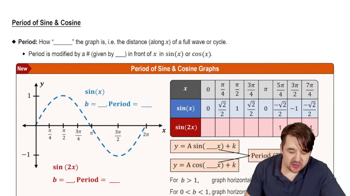
Determine the period of the function: The period of the secant function is the same as the cosine function, which is \( 2\pi \). Therefore, the period of \( \sec(x + \frac{\pi}{4}) \) is also \( 2\pi \).
Identify the phase shift: The expression \( x + \frac{\pi}{4} \) indicates a phase shift. The graph of the function is shifted to the left by \( \frac{\pi}{4} \) units.
Determine the vertical asymptotes: The secant function has vertical asymptotes where the cosine function is zero. Solve \( \cos(x + \frac{\pi}{4}) = 0 \) to find the asymptotes within one period.
Sketch the graph: Plot the vertical asymptotes, and sketch the secant function, which will have branches opening upwards and downwards between the asymptotes. Ensure the graph reflects the phase shift and covers one full period of \( 2\pi \).
Verified video answer for a similar problem:
This video solution was recommended by our tutors as helpful for the problem above
Play a video:
0 Comments
Key Concepts
Here are the essential concepts you must grasp in order to answer the question correctly.
Secant Function
The secant function, denoted as sec(x), is the reciprocal of the cosine function. It is defined as sec(x) = 1/cos(x). The secant function has a period of 2π, meaning it repeats its values every 2π units. Understanding the behavior of the cosine function is crucial, as the secant function will have vertical asymptotes where the cosine function equals zero.
Phase shift refers to the horizontal shift of a periodic function along the x-axis. In the function y = sec(x + π/4), the term (x + π/4) indicates a leftward shift of π/4 units. This shift affects the starting point of the graph and alters where the function's key features, such as asymptotes and intercepts, occur within the one-period interval.
Graphing periodic functions involves understanding their key characteristics, including amplitude, period, phase shift, and vertical asymptotes. For the secant function, it is essential to identify where the function is undefined (asymptotes) and where it intersects the x-axis. By plotting these features over a one-period interval, one can accurately represent the behavior of the function and its transformations.

 Verified step by step guidance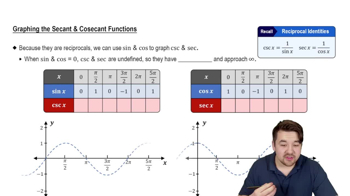
 6:22
6:22