
(Modeling) Length of a Sag Curve When a highway goes downhill and then uphill, it has a sag curve. Sag curves are designed so that at night, headlights shine sufficiently far down the road to allow a safe stopping distance. See the figure. S and L are in feet. The minimum length L of a sag curve is determined by the height h of the car's headlights above the pavement, the downhill grade θ₁ < 0°, the uphill grade θ₂ > 0°, and the safe stopping distance S for a given speed limit. In addition, L is dependent on the vertical alignment of the headlights. Headlights are usually pointed upward at a slight angle α above the horizontal of the car. Using these quantities, for a 55 mph speed limit, L can be modeled by the formula (θ₂ - θ₁)S² L = ————————— , 200(h + S tan α) where S < L. (Data from Mannering, F., and W. Kilareski, Principles of Highway Engineering and Traffic Analysis, Second Edition, John Wiley and Sons.) Compute length L, to the nearest foot, if h = 1.9 ft, α = 0.9°, θ₁ = -3°, θ₂ = 4°, and S = 336 ft.
3. Unit Circle
Trigonometric Functions on the Unit Circle
 3:08 minutes
Problem 3
Textbook Question
CONCEPT PREVIEW Match each trigonometric function in Column I with its value in Column II. Choices may be used once, more than once, or not at all.
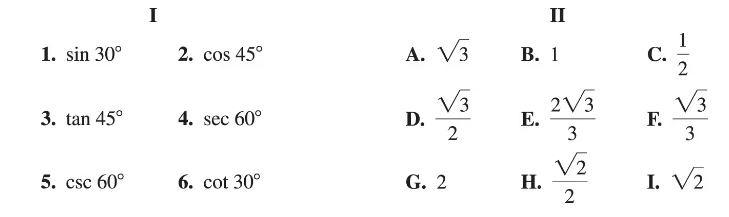
tan 45°
 Verified step by step guidance
1
Identify the trigonometric function given explicitly: tan 45°. Recall that tan 45° equals 1, so match tan 45° with value B (1).
Recall the common exact values of sine, cosine, and tangent for special angles such as 30°, 45°, and 60°. For example, sin 30° = 1/2, cos 60° = 1/2, sin 45° = cos 45° = √2/2, tan 60° = √3, and so on.
Match each trigonometric function from Column I with its corresponding exact value from Column II by comparing the known values. For instance, if you see sin 30°, match it with C (1/2); if you see cos 45°, match it with H (√2/2).
Use the Pythagorean identities and reciprocal relationships if needed to confirm matches. For example, since tan θ = sin θ / cos θ, if you know sin and cos values, you can find tan values to help with matching.
Double-check that each value from Column II is used appropriately according to the function's known exact values, and ensure no mismatches or contradictions occur.
Verified video answer for a similar problem:This video solution was recommended by our tutors as helpful for the problem above

Video duration:
3mKey Concepts
Here are the essential concepts you must grasp in order to answer the question correctly.
Basic Trigonometric Ratios
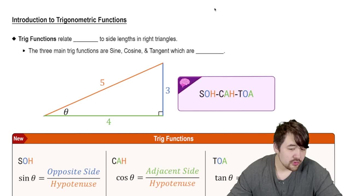
Trigonometric functions such as sine, cosine, and tangent relate the angles of a right triangle to the ratios of its sides. For example, tan 45° equals 1 because the opposite and adjacent sides are equal. Understanding these fundamental ratios is essential for matching functions to their values.
Recommended video:
 6:04
6:04
Introduction to Trigonometric Functions
Special Angles and Their Values
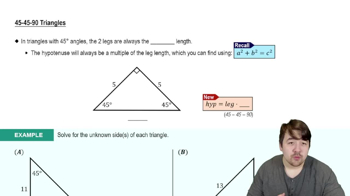
Certain angles like 30°, 45°, and 60° have well-known exact trigonometric values involving square roots and fractions. Memorizing these special angle values, such as sin 30° = ½ or cos 60° = ½, helps quickly identify correct matches without calculation.
Recommended video:
 04:39
04:3945-45-90 Triangles
Simplification of Radical Expressions
Trigonometric values often involve radicals like √2 or √3, sometimes divided by integers. Being able to simplify and recognize equivalent radical expressions, such as √3/2 or 2√3/3, is crucial for correctly matching the function values given in different forms.
Recommended video:
 6:36
6:36Simplifying Trig Expressions
Related Videos
Related Practice
Textbook Question
618
views