Graph each function over a two-period interval. y = cos (x - π/2 )
Verified step by step guidance
1
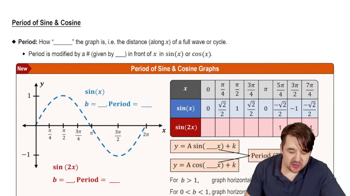
Identify the base function and its characteristics. Here, the base function is \(y = \cos x\), which has a period of \(2\pi\) and an amplitude of 1.
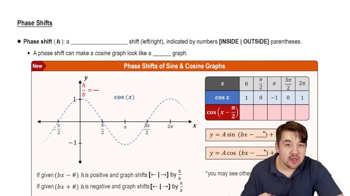
Understand the transformation inside the cosine function. The function is \(y = \cos(x - \frac{\pi}{2})\), which represents a horizontal shift (phase shift) of \(\frac{\pi}{2}\) units to the right.
Determine the interval for graphing. Since one period of \(\cos x\) is \(2\pi\), a two-period interval will be \(4\pi\). Choose an interval such as \([0, 4\pi]\) or \([-\pi, 3\pi]\) to cover two full periods.
Plot key points by evaluating the function at important values within the interval, such as at multiples of \(\frac{\pi}{2}\), considering the phase shift. For example, calculate \(y\) at \(x = \frac{\pi}{2}, \pi, \frac{3\pi}{2}, 2\pi\), etc., by substituting into \(y = \cos(x - \frac{\pi}{2})\).
Sketch the graph using the plotted points, showing the wave pattern shifted to the right by \(\frac{\pi}{2}\), maintaining the amplitude and period of the original cosine function over the two-period interval.
Verified video answer for a similar problem:
This video solution was recommended by our tutors as helpful for the problem above
Play a video:
0 Comments
Key Concepts
Here are the essential concepts you must grasp in order to answer the question correctly.
Graphing Trigonometric Functions
Graphing trigonometric functions involves plotting their values over a specified interval to visualize their periodic behavior. For cosine functions, the graph oscillates between -1 and 1, repeating every 2π units. Understanding the shape and key points of the cosine curve is essential for accurate graphing.
A phase shift occurs when the input variable x is adjusted inside the function, such as in y = cos(x - π/2). This shifts the graph horizontally by the specified amount—in this case, π/2 units to the right—without changing the shape or period of the function.
The period of the cosine function is the length of one complete cycle, which is 2π. When graphing over a two-period interval, you plot the function from 0 to 4π (or any interval of length 4π) to capture two full oscillations of the cosine wave.

 Verified step by step guidance
 6:04
6:04