Graph each function over a one-period interval. y = -½ cos (πx - π)
Verified step by step guidance
1
Identify the standard form of the cosine function: \( y = a \cos(bx - c) + d \). In this case, \( a = -\frac{1}{2} \), \( b = \pi \), \( c = \pi \), \) and \( d = 0 \).
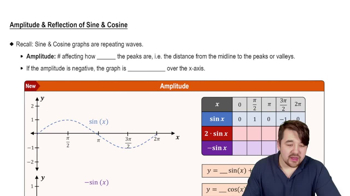
Determine the amplitude of the function, which is the absolute value of \( a \). Here, the amplitude is \( \left| -\frac{1}{2} \right| = \frac{1}{2} \).
Calculate the period of the function using the formula \( \frac{2\pi}{b} \). Substitute \( b = \pi \) to find the period: \( \frac{2\pi}{\pi} = 2 \).
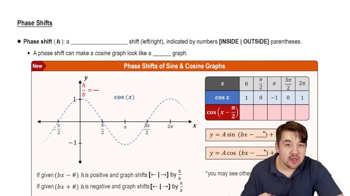
Find the phase shift by solving \( bx - c = 0 \). Substitute \( b = \pi \) and \( c = \pi \) to get \( \pi x - \pi = 0 \), which simplifies to \( x = 1 \). The phase shift is 1 unit to the right.
Graph the function over one period \([0, 2]\) by plotting key points: start at the phase shift, mark the maximum, minimum, and intercepts based on the amplitude and period, and sketch the cosine curve.
Verified video answer for a similar problem:
This video solution was recommended by our tutors as helpful for the problem above
Play a video:
0 Comments
Key Concepts
Here are the essential concepts you must grasp in order to answer the question correctly.
Cosine Function
The cosine function is a fundamental trigonometric function defined as the ratio of the adjacent side to the hypotenuse in a right triangle. It is periodic with a period of 2π, meaning it repeats its values every 2π units. The graph of the cosine function is a wave that oscillates between -1 and 1, with peaks at even multiples of π and troughs at odd multiples of π.
Phase shift refers to the horizontal shift of a periodic function along the x-axis. In the function y = -½ cos(πx - π), the term (πx - π) indicates a phase shift. Specifically, it shifts the graph to the right by 1 unit (π/π = 1), altering the starting point of the cosine wave without changing its amplitude or period.
Amplitude is the maximum distance a wave reaches from its central axis, which in the case of the cosine function, determines the height of its peaks and the depth of its troughs. For the function y = -½ cos(πx - π), the amplitude is ½, meaning the graph will oscillate between ½ and -½. The negative sign indicates that the graph is reflected over the x-axis, inverting the usual cosine wave.

 Verified step by step guidance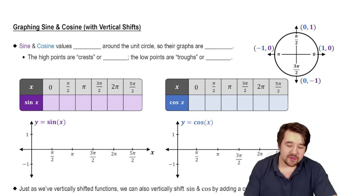
 5:53
5:53