For each function, give the amplitude, period, vertical translation, and phase shift, as applicable. y = 2 - sin(3x - π/5)
Verified step by step guidance
1
Identify the general form of the sine function: \(y = A \sin(Bx - C) + D\), where \(A\) is the amplitude, \(\frac{2\pi}{B}\) is the period, \(D\) is the vertical translation, and the phase shift is given by \(\frac{C}{B}\).
Rewrite the given function \(y = 2 - \sin(3x - \frac{\pi}{5})\) to match the general form. Notice that \(2 - \sin(3x - \frac{\pi}{5})\) can be seen as \(y = -\sin(3x - \frac{\pi}{5}) + 2\).
Determine the amplitude \(A\) by taking the absolute value of the coefficient in front of the sine function. Here, the coefficient is \(-1\), so \(A = | -1 | = 1\).
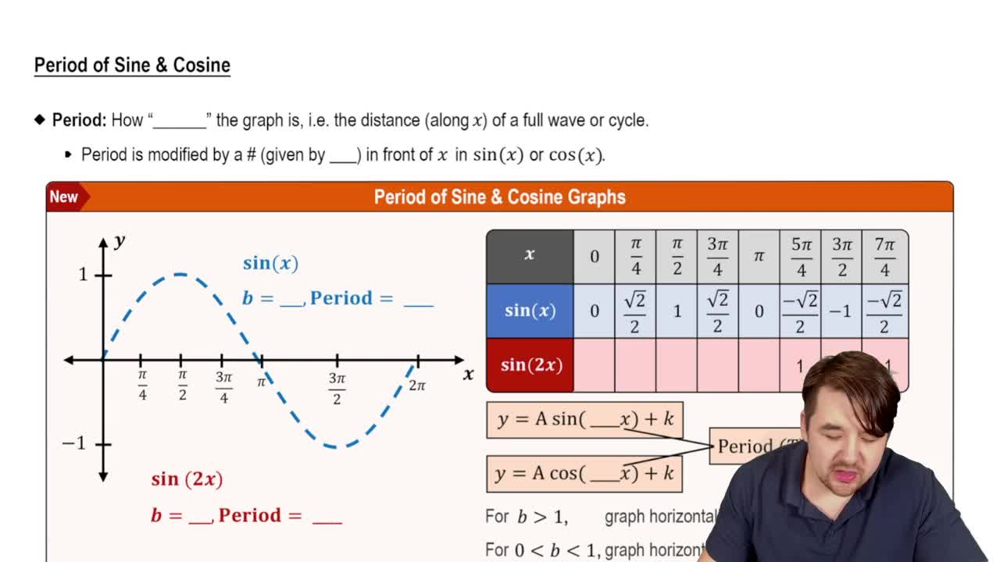
Calculate the period using the formula \(\text{Period} = \frac{2\pi}{B}\), where \(B\) is the coefficient of \(x\) inside the sine function. Here, \(B = 3\), so the period is \(\frac{2\pi}{3}\).
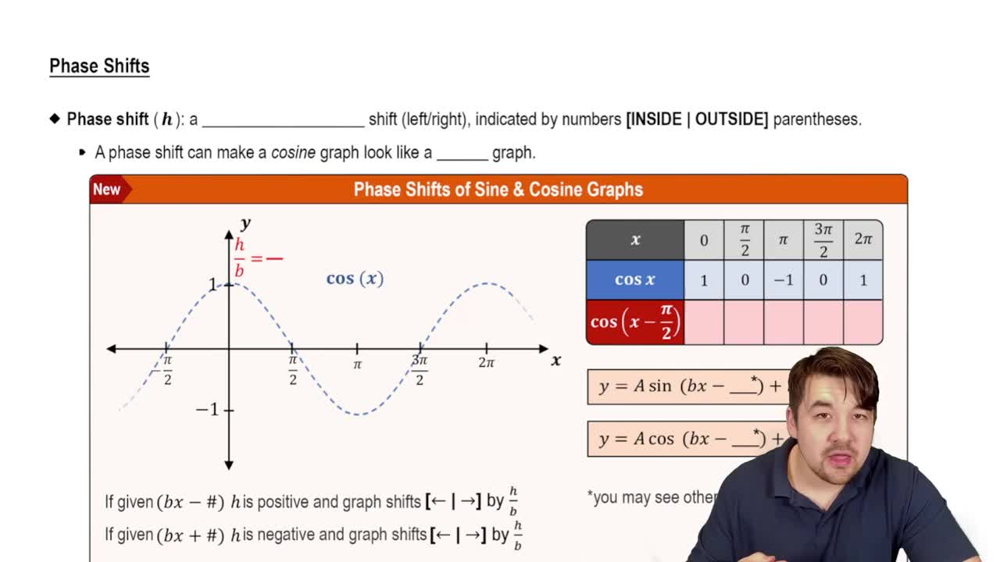
Find the vertical translation \(D\), which is the constant added outside the sine function. Here, \(D = 2\). Then, find the phase shift by dividing \(C\) by \(B\): \(\text{Phase shift} = \frac{\frac{\pi}{5}}{3} = \frac{\pi}{15}\). Since the function is \(\sin(3x - \frac{\pi}{5})\), the phase shift is to the right by \(\frac{\pi}{15}\).
Verified video answer for a similar problem:
This video solution was recommended by our tutors as helpful for the problem above
Play a video:
0 Comments
Key Concepts
Here are the essential concepts you must grasp in order to answer the question correctly.
Amplitude of a Trigonometric Function
Amplitude measures the maximum distance a sine or cosine function's graph reaches from its midline. It is the absolute value of the coefficient before the sine or cosine term. For y = 2 - sin(3x - π/5), the amplitude is | -1 | = 1, since the sine coefficient is implicitly -1.
The period is the length of one complete cycle of the sine function. It is calculated as 2π divided by the absolute value of the coefficient of x inside the function. For y = 2 - sin(3x - π/5), the period is 2π/3, reflecting how the function compresses horizontally.
Vertical translation shifts the graph up or down and is given by the constant added outside the sine function, here +2. Phase shift moves the graph horizontally and is found by solving the inside of the sine function for zero: 3x - π/5 = 0, so the phase shift is π/15 units to the right.