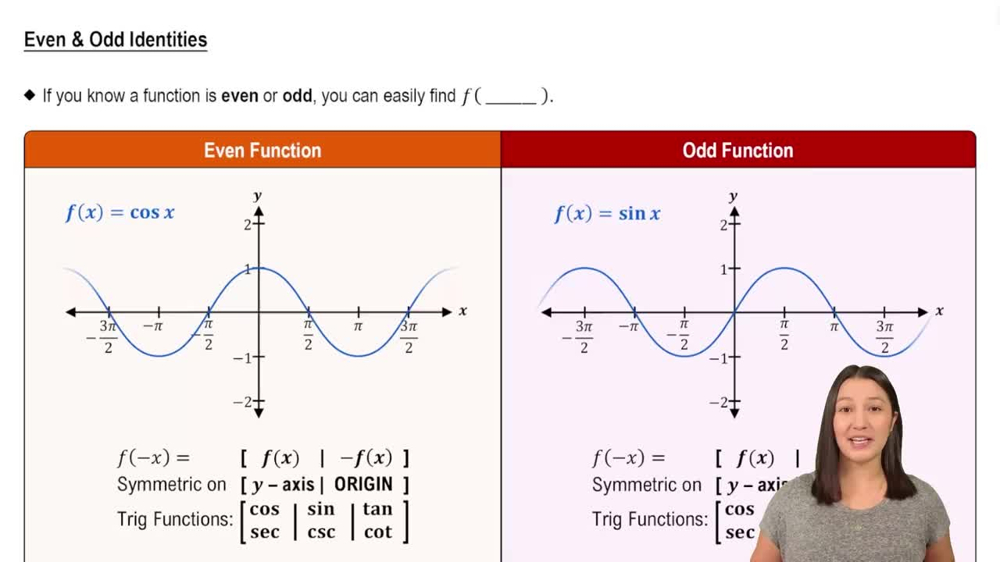
Decide whether each statement is true or false. If false, explain why. The graph of y = sec x in Figure 37 suggests that sec(-x) = sec x for all x in the domain of sec x.
Verified step by step guidance
1
Recall that the secant function is defined as \( \sec x = \frac{1}{\cos x} \).
Consider the property of cosine: \( \cos(-x) = \cos x \), which indicates that cosine is an even function.
Using the property of cosine, substitute into the secant function: \( \sec(-x) = \frac{1}{\cos(-x)} = \frac{1}{\cos x} = \sec x \).
Since \( \sec(-x) = \sec x \), the secant function is also an even function.
Therefore, the statement \( \sec(-x) = \sec x \) is true for all \( x \) in the domain of \( \sec x \).
Verified video answer for a similar problem:
This video solution was recommended by our tutors as helpful for the problem above
Play a video:
0 Comments
Key Concepts
Here are the essential concepts you must grasp in order to answer the question correctly.
Secant Function
The secant function, denoted as sec(x), is defined as the reciprocal of the cosine function: sec(x) = 1/cos(x). It is important to understand its properties, including its domain and range, as well as its periodic nature. The secant function is undefined wherever the cosine function is zero, leading to vertical asymptotes in its graph.
A function is classified as even if f(-x) = f(x) for all x in its domain, meaning its graph is symmetric about the y-axis. Conversely, a function is odd if f(-x) = -f(x), indicating symmetry about the origin. Recognizing whether a function is even or odd is crucial for determining the behavior of functions like secant in relation to their inputs.
Graphical interpretation involves analyzing the visual representation of a function to understand its properties and behaviors. For the secant function, examining its graph can reveal symmetries and periodicity. In this case, observing the graph of y = sec(x) helps to confirm whether sec(-x) equals sec(x), which is essential for validating the statement in the question.

 Verified step by step guidance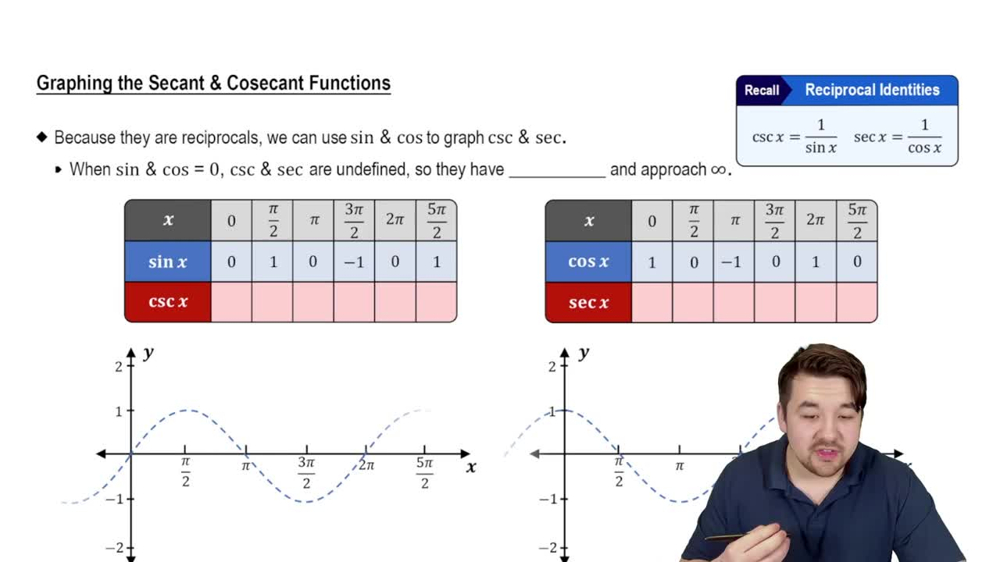
 6:22
6:22