Ch. 4 - Graphs of the Circular Functions
Lial - Trigonometry 12th Edition
Lial12th EditionTrigonometryISBN: 9780136552161Not the one you use?Change textbook
Chapter 5, Problem 4.43

A rotating beacon is located at point A, 4 m from a wall. The distance a is given by
a = 4 |sec 2πt|,
where t is time in seconds since the beacon started rotating. Find the value of a for each time t. Round to the nearest tenth if applicable.
<IMAGE>
t = 1.24

Verified step by step guidance
1
Identify the given function for the distance: \( a = 4 |\sec(2\pi t)| \).
Substitute the given time \( t = 1.24 \) into the function: \( a = 4 |\sec(2\pi \times 1.24)| \).
Calculate the angle in radians: \( 2\pi \times 1.24 \).
Determine the secant of the calculated angle: \( \sec(\text{angle}) = \frac{1}{\cos(\text{angle})} \).
Multiply the absolute value of the secant by 4 to find \( a \).

Verified video answer for a similar problem:

This video solution was recommended by our tutors as helpful for the problem above.
Was this helpful?

Key Concepts

Here are the essential concepts you must grasp in order to answer the question correctly.

Secant Function

The secant function, denoted as sec(x), is the reciprocal of the cosine function. It is defined as sec(x) = 1/cos(x). In the context of the given equation, sec(2πt) describes how the distance 'a' changes with time 't' as the beacon rotates, highlighting the relationship between circular motion and trigonometric functions.
Recommended video:
6:22
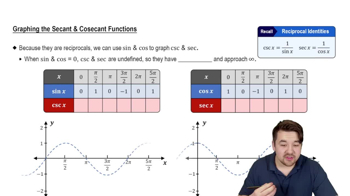
Graphs of Secant and Cosecant Functions

Trigonometric Functions and Time

Trigonometric functions, such as sine, cosine, and secant, are periodic and depend on the angle, which can be expressed in terms of time when dealing with rotating objects. In this case, the angle is represented as 2πt, indicating that the beacon completes one full rotation every second, thus affecting the distance 'a' over time.
Recommended video:
6:04
Introduction to Trigonometric Functions

Rounding and Precision

Rounding is the process of adjusting a number to a specified degree of accuracy, often to make it easier to work with or to present. In this problem, the instruction to round the value of 'a' to the nearest tenth emphasizes the importance of precision in mathematical calculations, particularly when interpreting results in real-world contexts.
Recommended video:
2:22
Cardioids Example 1