In Exercises 27–36, write each complex number in rectangular form. If necessary, round to the nearest tenth.8(cos 7π/4 + i sin 7π/4)
Verified step by step guidance
1
Recognize that the given complex number is in polar (trigonometric) form: \(r(\cos \theta + i \sin \theta)\), where \(r = 8\) and \(\theta = \frac{7\pi}{4}\).
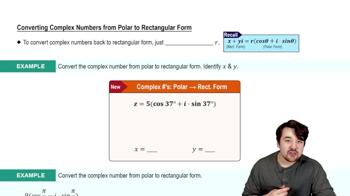
Recall that to convert from polar form to rectangular form, use the formulas: \(x = r \cos \theta\) and \(y = r \sin \theta\), where \(x\) is the real part and \(y\) is the imaginary part.
Calculate the real part: \(x = 8 \times \cos \left( \frac{7\pi}{4} \right)\).
Write the rectangular form as \(x + yi\), substituting the values found for \(x\) and \(y\). If necessary, round the values to the nearest tenth.
Verified video answer for a similar problem:
This video solution was recommended by our tutors as helpful for the problem above
Video duration:
4m
Play a video:
0 Comments
Key Concepts
Here are the essential concepts you must grasp in order to answer the question correctly.
Polar Form of Complex Numbers
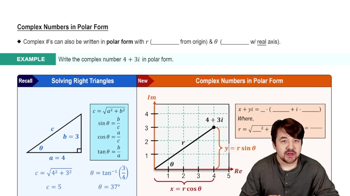
A complex number can be expressed in polar form as r(cos θ + i sin θ), where r is the magnitude (distance from the origin) and θ is the argument (angle with the positive real axis). This form is useful for multiplication, division, and finding powers or roots of complex numbers.
To convert a complex number from polar to rectangular form, use the formulas x = r cos θ and y = r sin θ, where x is the real part and y is the imaginary part. The rectangular form is written as x + iy, which is often easier to interpret and use in algebraic operations.
Converting Complex Numbers from Polar to Rectangular Form
Evaluating Trigonometric Functions at Specific Angles
Understanding the values of cosine and sine at common angles, such as 7π/4, is essential. For 7π/4 (or 315°), cos(7π/4) = √2/2 and sin(7π/4) = -√2/2. These values help accurately convert the complex number into its rectangular form.